Showing posts with label Ueno. Show all posts

An Evening Stroll in Ueno

When I don't have any other plans, and I still need to get out of the house, I tend to take a usual route from Akihabara, to Jinbocho, to Takadanobaba, to Ikebukuro. Some of the travel is by train, while a lot of it is on foot, so I get a bunch of exercise.

Every once in a while I'll head back to one of the other parts of town; recently, I was in the Ueno area to help out my friend and have some dinner.
 I've written about Ameyoko in the past. It's the major shopping street just south of Ueno, next to and under the train tracks. I spent a decent part of the afternoon wandering around some of the shops. I discovered an Okinawan store down one of the side streets, and a pet shop near that. The puppies looked so lonely.
 After we each had a kebab sandwich, which are pretty easy to find in that area and are really delicious, we strolled through the southern portion of Ueno Park. I've never really noticed the lanterns lining the walkway before, but then I've never been in Ueno Park at night. There are a few different Ukiyoe images that are found on the dozens of walkway lanterns.
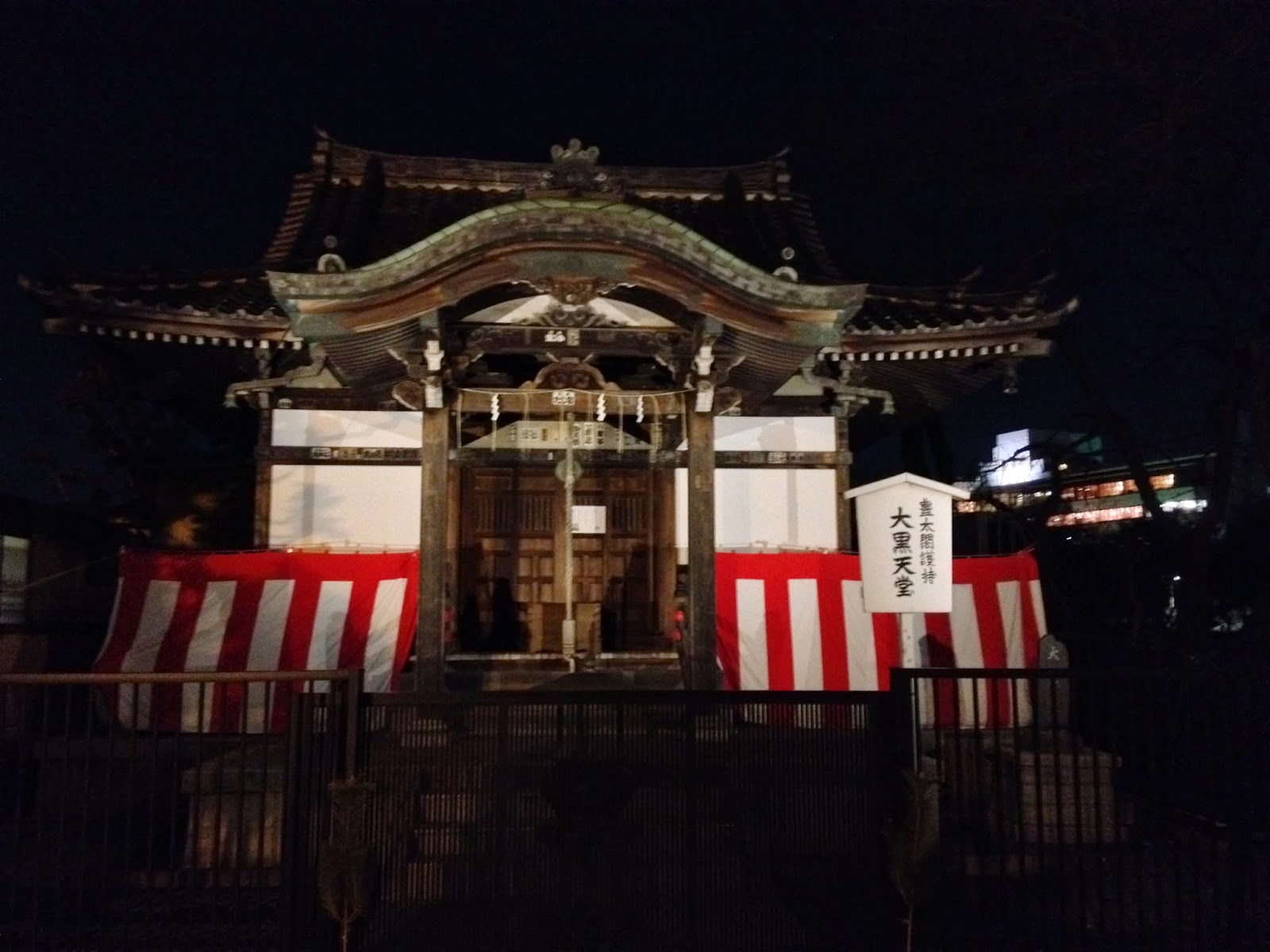
 Ueno has two temples, one up the hill and one below. The one up the hill was lit up with spotlights.
 Heading up the stairs, I saw the temple in its completely-shuttered state, something I don't think I've ever seen.
 Back at the bottom, we wandered over to Bentendo. It was a Sunday evening, so the decorations and tents must have been from something that day.
 Bentendo closes its doors as well, but at least this temple has more to it on the outside!
 One of Bentendo's shrines.
 Heading back toward Ueno Station, we noticed a recycling bin with a little bit of artistic freedom.
 Something else I don't recall seeing before was found at the southern end of Ueno Park - this panda shrubbery.
The panda has a friend! My friend is obsessed with pandas, but I think she's seen this before or she was really tired, because she had no interest at all in them. So we headed back to the station and said our goodbyes for the night.

It's nice to know that in a city like Tokyo, I can still find new things, and that there are so many neighborhoods to return to and re-explore.

Ueno Park's Bentendo Temple

 Ueno Park has a lot to offer. The main draws are the great museums and the pandas at the zoo, but there are a couple temples to visit as well. Ueno Park used to be part of Kaneji Temple, but after the civil war in 1868 wiped out the temple grounds, it was turned into a public park. A modest version of Kaneji Temple itself still exists, northwest of the park. Other parts of the temple remain today, though Bentendo is an independent temple enshrining Benten/Benzaiten, the goddess of fortune.
 It sits on an island of sorts at the south side of the park, surrounded by a lake (Shinobazu Pond) that is full of plant life.
 In the winter, it's quite bare, but in the warmer months it's a nice sea of green.
 There are several monuments around the temple.


 The temple was recently renovated and is now scaffolding-free. It looks as good as new!


 Just off to the side of the temple is an islet reached by a short bridge.
 This is another shrine, but it is closed to the public.
 With a fresh coat of paint, the temple's roof looks great.
 The front doors are ornately styled and the whole temple uses bold but simple colors.
 Inside, there is a large lantern and offering box, as well as some charms and fortunes on sale. Beyond that is the inner temple itself.
 This is the view from the back. A small bridge leads to another small building.
 The roof is worth a look too.
 The view of the pagoda portion of the temple from the back side.
 The temple from across the lake, on the south side.


Behind Bentendo, you will find paddle boats and swan boats to take a spin around the portion of the lake without lots of plants. It's supposed to be bad luck to do so with someone you love, though. During the cherry blossom season, Ueno Park, especially Bentendo, is packed with people and several stalls selling food are set up around the temple.

Bentendo is free and open year round from 7 AM until 5 PM; it is possible to walk past the temple at night as well although the doors are shut. The temple and Shinobazu Pond make up the lower portion of the park, accessible from JR Ueno Station as well as the subway and Keisei Ueno stations.

Location: Tokyo National Museum, Ueno

Rounding out my exploration of Ueno's museums is the highlight of the park's cultural attractions.
 The Tokyo National Museum sits at the north end of the park, across the road from the grand promenade, like the US Capitol overlooks the grounds of the Smithsonian.
 The museum grounds contain a few buildings. The building seen in the photo directly above mainly houses special exhibitions.
 A nice courtyard and garden is off to the side of the museums for relaxing. But you're concerned with the exhibits.
 They can be found in this building right in front.
 As you approach, you see a nice pond with well-trimmed hedges.
 If you arrive at the right time of year, you might just see the ume (ooh-may; plum) or sakura (sah-koo-rah; cherry) blossoms. Go in the museum. You'll like what you see.
 As an overview, I'll share some of what I saw. Above are some vases and a plate. One of my favorite types of art from Japan (and Asia) is the pottery. Plates, bowls, and vases are all ornately painted and quite beautiful.
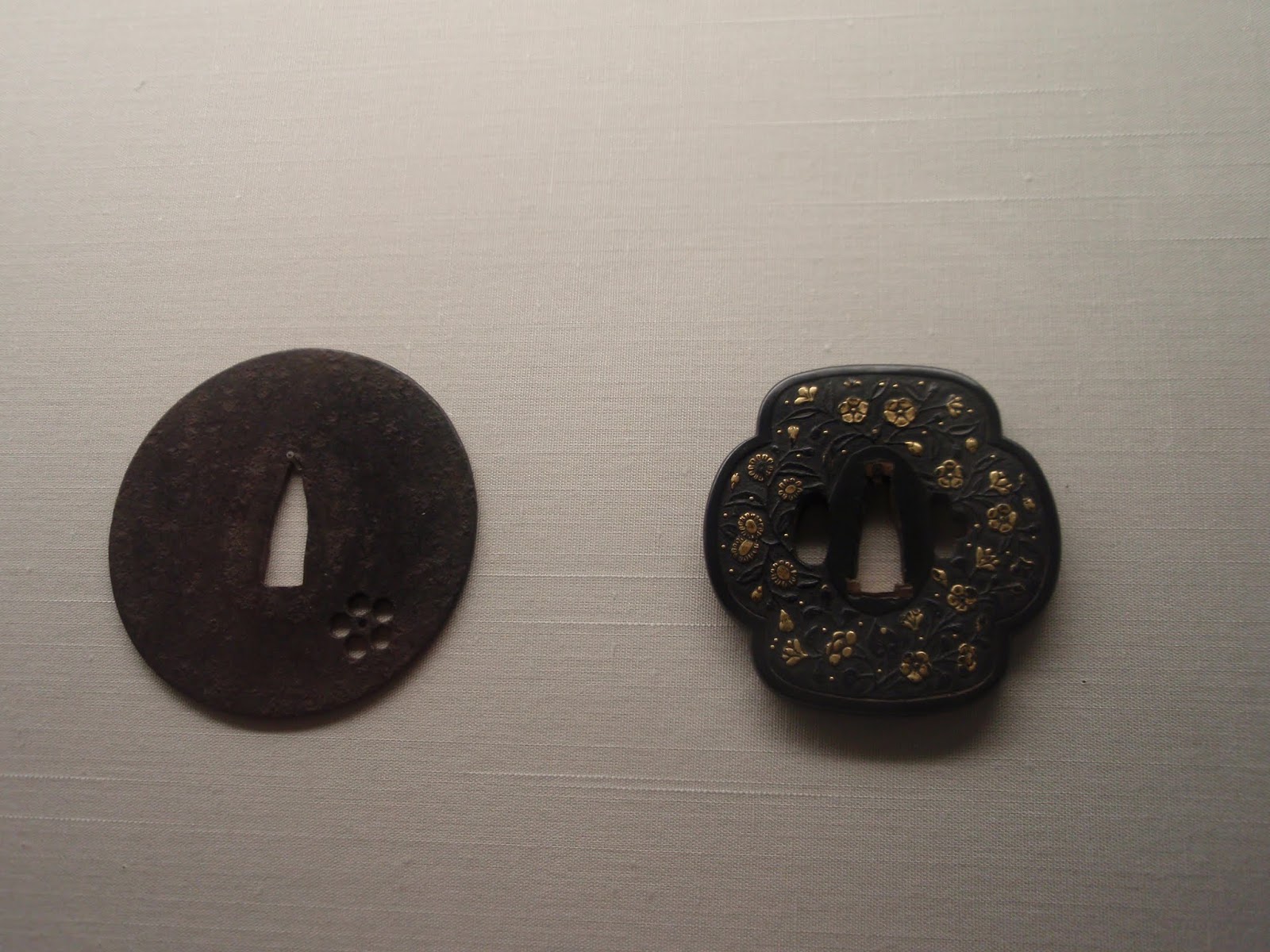
 Japanese enjoy looking at swords, but here they are split up into their pieces to better-acknowledge the handiwork. Above are some hilts.
 Here are some other pieces to be found on swords. Not seen are the blades themselves, which also are on display in the museum. While the handlework and ornamentation is quite beautiful, swords aren't quite my cup of tea.
 Religion is a very important part of Japan's history, culture, and art.
 Plenty of statues and other artwork related to religious symbols can be found on display.
 Scrolls from Japan's past carry a vast amount of history, and many times are passed from generation to generation. You can see a red spot on the bottom-right of the photo which might indicate ownership; many Asian emperors would stamp their seal on important pieces of work as they came to own them. I'm not sure how popular that was in Japan. Japanese calligraphy is beautiful in and of itself, and I would like to have a scroll similar to this (not historical, just perhaps a handmade modern document).
 This might be the coolest piece on display in the museum. Japanese armor is quite beautiful and ornate, and often have scary faces designed into the mask.
 Here you can see a closeup of the detail on the armor.
 Also beautiful are lacquer boxes, often with several mini-boxes inside. Again, a neat item worth having a modern reproduction of.
Last, a few netsuke from the museum's large collection. Netsuke were small trinkets used generally to keep pouches closed. There are many different types; a small overview is found on Wikipedia's page.

The museum is designed with foreigners in mind; English (and other language) information is widely available. It's open 9:30-5 pm or later every day except Monday (Tuesday if Monday is a holiday). Admission is 600 yen, a small price to pay for a great look at Japan's historical artifacts. You can easily get there from Ueno Station; it's at the north end of Ueno Park.

Now that I've finished with Ueno Park (I haven't been to the zoo or the recently-reopened Metropolitan Art Museum) I can move on to other locations in Japan! Kyushu, here we come...