Showing posts with label temples. Show all posts

Outside Kyoto's Shoren-in Temple

After visiting Kiyomizu-dera Temple, stopping by Kodai-ji Temple, walking through Yasaka Shrine, and exploring Chion-in Temple, all in the same day, my last stop on my Higashiyama walk that also included a park, historic streets, and food sampling was somewhat uninspiring.

That isn't to say that Shorenin Temple is boring. But let's face it, five temples/shrines in one day is a lot, and at this point I was pretty much exhausted. 
 Shoren-in Temple is probably most famous for its trees. There are several very old camphor trees on the temple grounds, and they are visible from outside the temple.
 I didn't go into the temple because I was quite tired. But inside the gates, you'll find a few very nice buildings that don't look the same as all the other buildings, some portraits on the walls and paintings on the sliding doors, and a beautiful garden. You can sit in the Kachoden drawing room on the tatami mats and admire the garden while relaxing for a while, before you explore the other buildings using the wooden walkways to get between them. You can also stroll through the garden to get a closer look and visit the tea house up a small hill.
Shorenin is open 9:00-17:00, though it has special extended evening hours in the spring and fall. Admission is 500 yen, though there is a special fee for the evening illuminations.

It's located just north of Chorenin; you can see the entrance in the photo above. You can also get to Shorenin from Higashiyama Station on the Tozai Line - buses 5 and 100 stop nearby though I'm not sure exactly where. The subway and bus stops are about five minutes away, which makes Shorenin the perfect place to end your day.

However, you can continue east to Nanzenji, Eikando, Philosopher's Path, and finally Ginkakuji from here, if you're an ambitious walker. But due to the large number of sites in this area, it's best to break this up into two days, or even three.

Kyoto's Chionin Temple

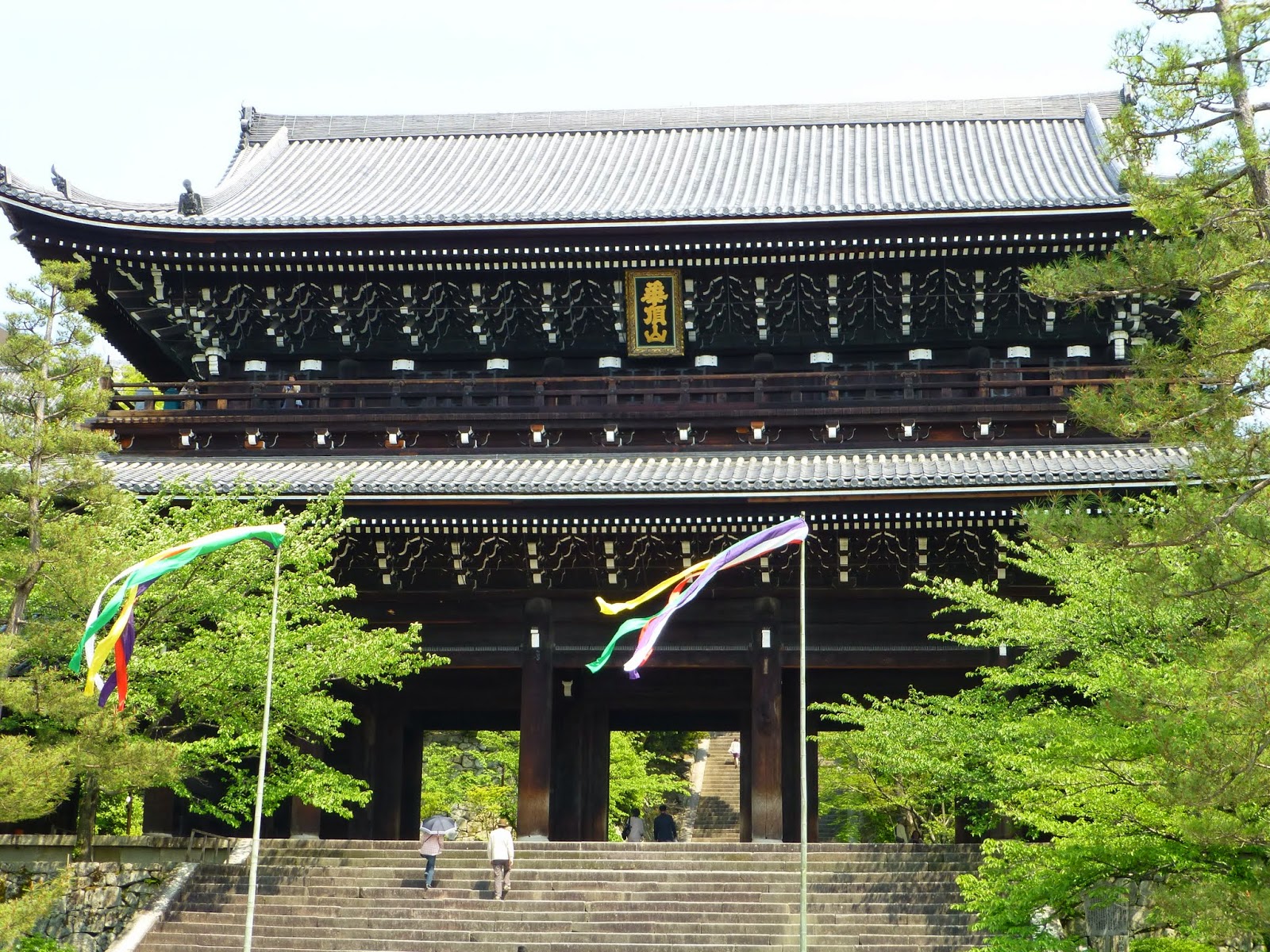
 Chionin is the main temple of the Jodo sect of Japanese Buddhism, which (seemingly like every Buddhist sect in Kyoto) is one of the most popular in Japan. You start at the massive Sanmon Gate.
 The grounds are spacious and beautiful, including the hike up stairs.
 There are several buildings on the grounds, a massive bell, and a mausoleum.
 The main hall (called Miedo Hall) is currently covered and undergoing renovation. The Mido Hall is functioning as a replacement until renovations are complete some time in 2019.

 While you can't access the Miedo Hall you can see just a bit of the reconstruction efforts.

 Many of the important artifacts are on display in nearby buildings.
 The doors are particularly beautiful. There is also a statue of Amida Buddha in Amidado Hall.


 Behind Miedo Hall are paths that lead up the hill to several smaller buildings.

 This is Amidado Hall.
 In addition to the buildings in the hillside, you'll find a garden and cemetery.


 It's a beautiful temple, especially once you get past the main area and enter the gardens and see the smaller temples.

 For tourists, it doesn't really have any outstanding features. But you'll be in the area anyway, and it is a beautiful, quieter temple to visit in the afternoon.
Chionin Temple is located just north of Maruyama Park. The grounds are always open, but the buildings are open 9:00-16:30; admission is free. Entry to Hojo Garden is 400 yen, Yuzen Garden is 300 yen, and a combination ticket is just 500 yen. I didn't visit the gardens due to time constraints but I hope to find time to return to Kyoto and see them at some point.

Kyoto's Kiyomizu-dera: A Top Three Destination

 They say you get sick of temples after sightseeing in Japan as much as I have. But Kyoto is the "home" of temples and there are some very nice ones in town. Kiyomizu-dera, like many of the famous temples, has something unique to call its own.
 Located in the hills on the east side, the approach is a somewhat tough but short uphill walk including many of the stairs. You know you're there when you reach the gate.
 Depending on your approach, you will walk up or down the shopping street that leads to the temple. This is a good area to browse, perhaps get a snack like matcha (green tea) ice cream, and if it's the end of the day get some of your souvenirs.
 But the temple itself, set back in the trees, is quite attractive.
 Actually, the area in front of the temple is perhaps the most beautiful spot, with the stone statues, steps, and gate in the background.
 It's perfect for some young ladies wearing yukatas or kimonos to take some pictures.
Photos with and without the girl. Take your pick.

The inner temple itself was so crowded I had to skip it when I visited. I'll hopefully be able to visit again when it's not so busy to see what lies in the paid area. There are several spots on the temple grounds worth visiting, including some nice views of the area or of the temple itself, and a couple areas which are said to bring good luck by completing some tasks.

Before entering the paid area, there is another one of those small buildings, called Zuigudo Hall. For a separate small fee here you can wander through a pitch black basement that is supposed to symbolize a mother's womb. This was my second time traveling through a dark passageway at a temple - the other two were in Nagano and in Tokyo. Zuigudo's experience was better than Nagano's Zenkoji, mainly due to the crowding in Zenkoji. Tokyo's Gyokushin Mitsuin Temple was the best so far, though it wasn't pitch black for the entire journey.

So it's a top three because it's one of three with pitch black tunnel adventures. But it's also one of the three most important places to visit in Kyoto: Kinkakuji, Ginkakuji, and the Higashiyama District.

Entry into Kiyomizu-dera is only 300 yen, and it's open 6:00-18:00 year round. The easiest access is by bus 100 or 206 from Kyoto Station; get off at Gojo-zaka or Kiyomizu-michi and walk about 10 minutes uphill. The temple is located at the southern end of Higashiyama, which has plenty to see as well; the Higashiyama area can easily take a full day to explore and appreciate.

Kinkakuji Temple (The Golden Pavilion) in Kyoto: Very Beautiful and Overhyped

When sightseeing in specific countries or cities, there are places you just have to go. In London, you see Big Ben and Buckingham Palace. Paris has the Eiffel Tower. New York has the Statue of Liberty. And Kyoto has Kinkakuji.
 Kyoto is certainly well-known for its cultural and religious sightseeing landmarks, but there are a few places every Japanese traveler has been to if they've gone to Kyoto on vacation. One of those is Kinkakuji. The name sounds wonderful: it translates as Golden Pavilion. And it lives up to its name: it is a pavilion of gold. But how great is this old, historic, valuable building?
 After paying your money and entering the gates, you begin the approach. The temple is set a little ways back from the gates, on the opposite side of a lake.
 And that's where you first see it. Kinkakuji really is a pavilion covered from top to bottom in gold.
 Well, almost bottom. The first floor is just wood. Each floor has a different architectural style: the first is Shinden style, used for palaces in the Heian Period. The second floor is Bukke style used in samurai residences, covered in gold on the outside, and houses statues that are never shown to the public. The third floor is a traditional Chinese Zen hall, and is gold both inside and out.
The building has burned down several times, most recently in 1950 due to a fanatic monk. The current building was finished in 1955.
It is quite difficult to see, especially because my photos are a bit hazy, but the windows on the first floor are open, and you can see the statues inside. This is usually the case.
The pavilion is certainly well-placed with several beautiful angles to take pictures over the lake. Would you like a pine tree obscuring part of the building or not? Perhaps a small bit of an island in front of it to add some depth?
 The path continues and you end up on the back side of the pavilion, permitting you a closer look at the structure.
 All that gold is beautifully shiny, but there isn't any contrast which sadly means it also looks somewhat like a cheap toy. You know, one of those toys you got painted in gold paint? Or perhaps an inexpensive souvenir you bought by the side of the road?
 From the back, you can see the roof's topping: a golden phoenix. Too bad this view is from the back too. But if you ever wanted to see what a golden phoenix looked like in an up-skirt shot, well, there you go.
 Kinkakuji's grounds are nowhere near as impressive as Ginkakuji's, though there is a small cave.


 Heading along the trail you'll come to a small waterfall.
 Some rock carvings with lots of offerings. I believe if you toss a coin into the bowl and it stays inside, your wish comes true.
 A light forest with a stone pagoda next to another pond. I think there are some off-limits sacred grounds attached to Kinkakuji.
 Kinkakuji from a different angle, poking its best assets over the trees.
 Here's the phoenix from a slightly sideways angle. I guess a phoenix is a good choice for a building that has burned to the ground several times only to rise again.
 Another view of the stone pagoda.
 If you come on a busy day, like I did during Golden Week, you can expect the crowds to be quite heavy. The best viewing points of the golden pavilion will be swarming with tourists carrying very expensive cameras to take their awesome photos and cellphones to take their selfies.
There are some small shrines at which to pray near the end of the one-way path before you exit toward the gift shop. There is a tea house just before exiting, but you can enjoy matcha (green tea) and sweets at the tea garden just outside the gates. Fudo Hall, seen above, is nearby and houses a statue said to be carved by Kobo Daishi, one of the most important historical Japanese religious figures.

While the pavilion is amazing to see - an entire building covered in gold! - the one-trick-pony aspect of this site meant that I was really only paying to see a building. And I've done that before, but usually it includes a tour inside or some auxiliary sites; Ginkakuji had the beautiful gardens, observation towers have observation decks, and Abashiri Prison and other architectural museums tell interesting stories about the building and its use through exhibits and experiences.

That isn't to say Kinkakuji isn't worth visiting - it is. Just know what you're getting to see!

Bus numbers 101 and 205 go from Kyoto Station to Kinkakuji, the cheapest and easiest way to get there. However, Kyoto can have heavy traffic, so you can take the Karasuma subway line to Kitaoji Station and catch the 101, 102, 204, or 205 bus to the temple. The subway-bus route is more than double the price, though it is a bit faster and much more reliable on time.

Admission is 400 yen, and the grounds are open 9:00-17:00. While there are plenty of things to see and do in northern Kyoto, there really aren't any other tourist stops near Kinkakuji, so plan your onward destination before leaving Kyoto Station.