Showing posts with label sports. Show all posts

Nagano Olympic Museum at M-Wave

 M-Wave is the best place to visit to get a taste of the 1998 Winter Olympic Games. The venue was used for speed skating during the games and is currently used as a plublic ice skating rink in the winter and also as a training center for speed skating. The Olympic Stadium, used for the opening and closing ceremonies, White Ring, for figure skating and short track speed skating, and Big Hat, for hockey games, still stand and are used for sports and entertainment events and as sports facilities.
 Why is M-Wave so important? Because the venues are scattered around the city, seeing them all is very time consuming. M-Wave is located a good ways from Nagano Station, but it houses the Nagano Olympic Museum.
 It's possible to go into the arena and see the venue "up close" although you're confined to a somewhat small area. When I visited there were older children taking speed skating lessons on the outside track and some other events happening inside the ring, possibly short-distance speed skating for younger children. The back of the arena, from this perspective, has a rink which seemed to have some hockey practice.
 The museum itself is beneath the stands. A replica press area is the first thing you see, and you can have your picture taken at the podium. The back-lighting on the signs can make that difficult.
 After passing through the gift shop, which you'll return through on your way out, you get to the museum itself.
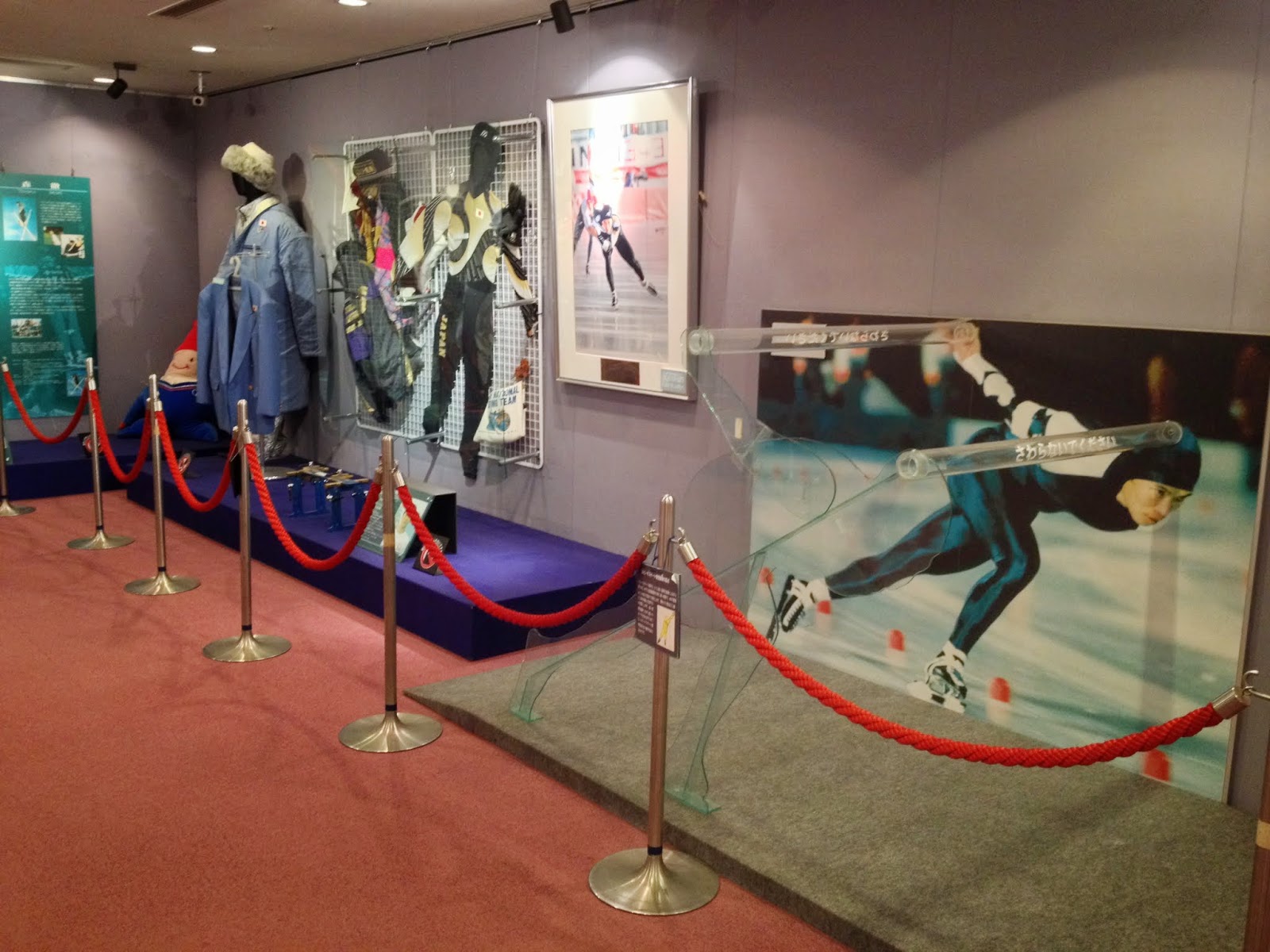
 The displays are fairly complete showing a little bit from every aspect of the games. Here are some costumes from the opening ceremonies.
 Medals and other memorabilia from both the Olympics and Paralympic Games are on display.
 Uniforms from the competitions...
 Merchandising...
 Bling...
 One part of the museum appears to be a touchy-feely area. By that, I think you're free to touch and pick up the different things used during the games.
 As you see, there are uniforms, skis, and even a curling puck.
 One wall had a display showcasing many of the games at the Nagano Olympics.
 You can sit in a fake bobsled and watch a movie, similar to the Sapporo museum.
 Bobsledding! Or whatever this is called, exactly. Since you're not in an enclosed sled.
 Ski jump! The 1990s colors and pose makes me think of one word: Cowabunga!
 There is some Paralympic Games equipment opposite the Olympic Games wall.
 I don't know what these were used for, but I wouldn't mind having something like this to put on my wall.
 The special exhibition room, which seems to double as a cafeteria, had a bunch of hockey memorabilia in cases.
 I saw a bunch of other goods in the hallway display cases. It's hard to really pinpoint this other than a collection of Olympic goods.
 Also in the wide hallway, you could take the pose of a figure skater. Note the clear outline profile.
 The museum isn't exactly large, but given that it's devoted to a one-time event over just a few days, it's pretty comprehensive. There's also a theater which showed a short film on a loop. As I mentioned, there is a gift shop with Olympic memorabilia and winter sports magazines including several issues of a Japanese figure skating magazine.
I'm not sure how you would wear these, but I think they're mascot costumes. You can't try, since they put up plastic chains. And in Japan, chains are as good as a force field. In fact, putting up a small sign seems to be good enough.

The Olympic Museum is open only on weekends 10:00-17:00, though the souvenir shop is also open on weekdays. Admission is free but there is essentially no English information. You should be able to figure most of it out just by looking at it, though you miss out on the story, history, and names.

To get to the museum by bus from Nagano Station, go to Bus Stop 1 and take a bus toward Suzaka & Yashima, getting off at the M-Wave-Mae bus stop, which takes about 15 minutes. The return bus stop is across the street. There isn't really anything else around M-Wave, so plan on returning to Nagano afterwards.

Have you ever seen a ski jump? Sapporo Winter Sports Museum

I've seen a kangaroo jump. I've seen a video jump. I've even seen a record jump.

But until this September, I had never seen a ski jump.

A little ways from downtown Sapporo, on Okurayama, the Winter Sports Museum has artifacts and interactive stations about the games held in the cold part of year. The best part of the museum for me, though, turned out to be seeing this:
 I don't watch the Olympics on TV very much. I'm just too busy. And it seems that most of the events will start around 1:00 or 2:00 in the morning this year. But I had never really imagined what a ski jump site really looks like in person - without the snow.
 It turns out that the entire complex is just a long, narrow line up the hill. There are judges' and press buildings along the side (including up the mountain), and the giant scoreboard up in the hillside. The landing area is on the hill with a modest flat area (actually, it slopes back up) for the skiier to stop.
 The launch is simply two narrow tracks - one for each ski. The skiier doesn't have to do too much to stay in line. And they get a nice lift back to the top.
 An area for spectators is on the right side and I'm sure the views are great from any "seat".
 Inside the museum, at the base of the jump, you get a nice skiing sculpture.
 You start upstairs in the exhibit zone. Skiing is the most prominent sport on display here. There is equipment from other sports as well (see the curling broom and puck on the right).
 Here's a display on great Japanese skiiers and the different Japanese skiing awards that can be won.
 A lot of old skis are on display, but I'm not sure if they're from famous skiiers or just leftovers from days past.
 At the end of the display on the history of skiing in Japan, visitors find a mock-up of a cabin with some more skis and other winter gear.
 But what about the Olympics? There's a long wall with lots of information on the locations used in the 11th Winter Games (1972). The ski jump and museum exists because of the 1972 Olympics, although the museum is about winter sports in general, not just the Olympics.
 You can also see a torch.
 The games themselves are can be viewed along another long wall.
 It is along this wall you can lift a real torch. There are several hands-on exhibits.
 The mark of quality. The mark of Sapporo 72.
 A display case full of medals. Here you can see that the biggest problem with this museum is the lack of English signage. I really wish they'd update the information to make it more foreigner-friendly.
 However, the museum more than makes up for it with hands-on displays. I think you are allowed to sit here.
 There certainly aren't any signs saying you can't sit in it!
 Nordic Skiing display, which is a sport I know nothing about. That can be said about most winter sports at the Olympics. But the uniforms (and how they change) are kinda neat.
 Not only are there hands-on displays throughout the museum, there are several digital games where you can "participate" in Olympic sports, downstairs in the bottom-floor Experience Zone. Some were quite popular, but they all felt a little dated. It would be great if this museum could gather enough funds to update the signage for foreigners (English - even just a real good color pamphlet) and the games.
 I'm not exactly sure what this display was, other than it must have been really good skiiers from Japan.
 Would you like to be a figure skater or snow boarder? Just take your picture here.
 Photo opportunities are all over the place. Would you like to pose with an Olympic hockey goalie?
 There are lots of little displays where you can touch and explore the equipment - skates, skiis, a hockey stick, etc. Again, a suggestion for the museum - due to the uniqueness of clothing used in the winter games, a dress-up area (you can try on costumes for samurai and geisha/meiko characters at other places) would be neat, though I don't know how that would work. Posing as the hockey goalie instead of with the hockey goalie would be even cooler.
 Off in the corner, you can see a series of lockers full of equipment from some of the better (best?) Japanese winter sports competitors. I'd assume that most, if not all of them have been to the Olympics, and, again, most, if not all, won at least one medal. (That's a lot of comma-filled clauses.) This is the Competition Information Zone, also on the first floor.
Bobsleigh! Cool Runnings was better. Just an example of the interactive "game" - you can sit in this bobsleigh and watch a (live action) movie from the point of view of the bobsleighers, but the sleigh doesn't move and you don't have any control. How much better would it be if you could control the sleigh and compete against others and yourself? All it would take is "controls" in the sleigh at the least (plus, of course, some form of video game instead of just a video), though it could become an entire motion-based unit.

While I have some criticisms of the museum, that's because it's so good and so close to being great. If you find yourself in Sapporo, and are a fan of Olympic games or the sports you can find in them, it's worth a visit. But it takes about 20 minutes to get to Okurayama, where the museum and jump is located; buses to/from Sapporo Station run every 30 minutes or so, and also go by the zoo. Just ask where to get the bus towar大倉山 (Okurayama). Admission is 600 yen, and the museum is open from 9:30 AM until 5:30 PM (6:00 PM May through October; Fridays and Saturdays until 9:00 PM June through September).

You can also take the ski lift to the top, which gives a better view of the launch area and (on clear days) the ability to see Sapporo and its surrounding countryside. I didn't use the ski lift, because a typhoon was moving in so it was rainy all day and the view was nonexistent. The fee is 500 yen round trip, or 250 yen one way. I guess you can walk back down, because I'm not taking the ski jump.

There's a Mongolian barbecue restaurant at the stadium, open for lunch 11:30-2:30 and dinner 5:30-9:30. The lunch menu is much cheaper, although you get a smaller portion. A building near the museum building, called the Crystal House, sells lots of souvenirs including Okurayama "exclusives" and several Hokkaido gifts. The Mongolian restaurant is located on the second floor of this building. Also, there is a cafe in the museum building.

If I can return to Sapporo, I will probably go back to the museum, if just to go to the top of the jump. Of course, timing the trip so that I can have lunch will be a priority.

A trip to the Japan Baseball Hall of Fame

Not just for the NPB, the Japan Baseball Hall of Fame honors important names in all aspects of Japan's baseball history. Start by entering the glass doors, paying your admission, and heading downstairs.
 The first exhibit has display cases for each NPB team.
 Cases hold memorabilia from several famous players from the team.
 Alex Ramirez's bat is on display, to which he added "zekkocho!!"
 Passing through, NPB's history and its greats are on display.
 This patch is from the early days of professional baseball: the NPBL Leading Hitter award for the 1937 autumn season.
 Sadaharu Oh, the Babe Ruth of Japan, has his own display case.
 Several other stars receive equal treatment, though.
 More autographed bats are on display... Ye, that's Randy Bass.
 Old awards and equipment are scattered out among the cases.
 The museum framed an old poster.
 Photos and materials from defunct teams show the beginnings of the NPB.
 More awards. More equipment.
 This plaque sat outside Korakuen Stadium, where Tokyo Dome and the museum is today.
 Ikuhara is a member of the Japan Baseball Hall of Fame because he was an assistant to Walter O'Malley with the LA Dodgers for several decades.
 Other nods to US baseball show up here and there. This base signed by Rickey Henderson notes Fukumoto's record of 1065 stolen bases - Henderson passed him in June of 1993.
 US players have traveled to Japan several times - here are a pair of jerseys from an old competition.
 Those really familiar with Japanese baseball should recognize this image.
 US teams over the years on signed baseballs. Babe Ruth is in there at least once.
 One display case had old trading cards - these had their original packaging.
 Karuta is a matching game. This deck has baseball players, and the characters are hiragana characters that match the romanji sounds. I'd love to have a full set of these.
 Here's a different view so you can see more of the cards.
 Once you get past the NPB exhibits, things turn unprofessional. Namely, college, high school, and little league.
 These rubber balls are called kenko balls, and are used in little leagues in Japan. They're softer, safer, and probably more durable in wetter weather.
 Japan is proud of any victories, including the Cal Ripken World Series.
 There was a small display of women's paraphernalia, including the national team jersey and some professional baseball jerseys.
 These are from the Girls Professional Baseball League, which has been renamed the Japan Women's Baseball League; there are now four teams in the league with completely different names and color schemes.
 Once you've finished with the non-NPB exhibits, you move into the actual Hall of Fame.
 Each honoree has a plaque, similar to the MLB HOF plaque, with a description of his accomplishments below. The card below the plaque has an English translation of the text on the plaque.
 A few plaques have an egg shape as they are special honorees instead of real members of the Hall of Fame. This is Lefty O'Doul, who helped make baseball popular in Japan. The Tokyo Giants are named such because of his involvement with the New York Giants.

The Hall of Fame members include NPB stars, team owners, college and high school stars, and managers from teams at all levels. Really, anyone associated with any field related to Japanese baseball can be found in the museum, which makes collecting cards of all the members impossible. I spent a lot of time photographing each plaque because some members don't even have readily available photos online.
 After leaving the Hall, a simple case displays the JWBL current jerseys and caps.
 There's also an autographed baseball on display. The league is young but barnstorms around Japan. And Japan loves women's sports much more than America does.
 Moving on, a three-dimensional mural is the highlight of a resting area.
 Tired museum attendees can sit in seats from old stadiums and watch baseball programming on the TV. I saw some of a high school or college game while I was there.
 Bullpen carts are cool.
 There is an interactive area, with a digital batting cage to test your hitting ability against great NPB pitchers. I was not successful at this game, and neither was anyone else I saw taking cuts.
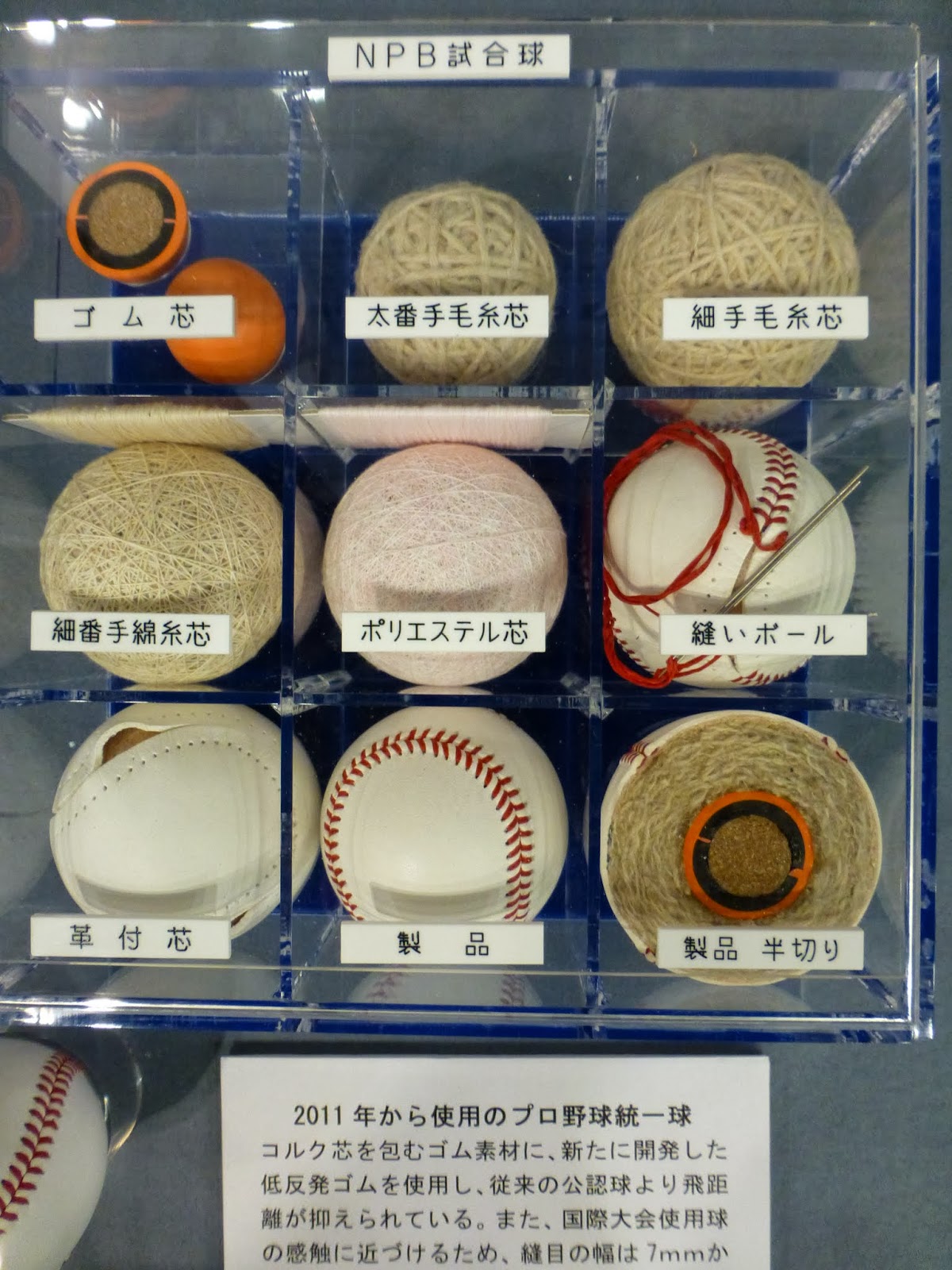
 If you've ever wondered how a baseball is made, in Japanese, you can find out here!
 They had balls from several leagues.
 There was a lot of other equipment on display, including this home plate and pitching rubber.
 The museum has a special exhibition room, and with the WBC being held just before my visit last year, it was packed with souvenirs from the prior competitions.
 Game used base from 2009.
 And a lineup card signed by Sadaharu Oh, with Ichiro as the leadoff batter and Koji Uehara as the starting pitcher.
The display even had a few items from the 2013 competitions, including a team signed ball and several autographed cards from players of many teams.

Heading back upstairs, you can find a small museum shop (more of a display case with goods for sale at the entrance) which has pins, a few books, official baseballs, and chopsticks made from broken bats.

Overall, the museum is smaller and less exciting than the Cooperstown counterpart, but for a smaller country with fewer teams, it certainly serves its purpose.

The museum is open from 10 AM to 6 PM, closing at 5 PM November through February. Admission is 500 yen, but a 100 yen discount coupon can be found on the website. The entrance is to the right of Gate 21 of Tokyo Dome, a short walk from Suidobashi, Kasuga, and Korakuen Stations.