Showing posts with label cars. Show all posts

Sweet Ride, Dude!

I don't know what this car is, but I saw it in Tokyo. It's certainly a nice ride! There are two distinct kinds of cars in Japan, as far as I can tell: functional and flashy. Sure, the functional cars have style, but they're designed to be as small and as roomy as possible at the same time. And as for the flashy cars, they are almost exclusively expensive sports or luxury cars. Sometimes you see a teenager's souped up car like you would see in the Fast and Furious movies. You know, the ones with loud exhausts just because?

Toyota Techno Museum in Nagoya: Everything Toyota, Ever

 Perhaps my title is a little bit of hyperbole, but unlike the Kaikan Museum and Automobile Museum, which both focus on, well, cars, the Toyota Techno Museum looks at some of the other industries Toyota is a part of.
 The museum is located in central Nagoya, a 20 minute walk or 10 minute tourist-bus ride from Nagoya Station. From the outside and in the entry lobby, you might have no idea if you're actually at a major car company's museum.
 And you're kind of right. The museum follows a loop around the building, starting with the company's involvement in the textile industry.
 Toyota really got its start in manufacturing various textile machines. The museum starts with a little bit of information on how thread and fabric was originally created by hand.
 Machines are on display that would separate, clean, spindle, and weave.
 The long machines are pretty impressive, even when they aren't working.
 Some of the equipment is capable of weaving patterns into the fabric. This one uses a punch card that tells it which threads to use at any point in the fabric.
 Larger, more modern machines are also on display, and some of them can be viewed in operation. Docents are eager to demonstrate their functions.
 Some machines use needles while others actually use water to weave the fabric! It's pretty impressive...
 This machine might be the most impressive. It uses a series of different-colored threads to weave digital images into fabric! No iron-on transfers or screen printing to rub off. I wish they had these for sale in the gift shop. Not only is this more efficient for small jobs than screen printing, it can last longer if quality non-fade threads are used.
 I believe this is the water jet weaving machine.
 The building is on the site where Toyoda built a textile mill. I'm not really sure if this is an original building from the factory or if it was rebuilt/built after the war.

 But, that's enough about textiles. It's Toyota. And for most of the world, Toyota means automobiles. Head down this room...
 And into the workshop where the first prototypes were created. Lots of machinery is on display as well as parts.
 The garage has some displays showing how it might have looked decades ago when they were creating those first Toyota automobiles.
 As you can tell, the company was heavily influenced by American design; I recall reading in the literature that some US parts were used either as models to be improved upon, or in the first cars.
 After exploring the small building replicating the original working conditions, it's time to see some actual cars. There's a gigantic hall featuring almost everything related to automobile manufacturing.
 What does a car look like if you strip it down to the bare minimum?
 A long row of different engines on display.
 A display showed the evolution of Toyota dashboards over the years.
 The old 1930s/1940s vehicles are always fun to look at!
 An old delivery truck!
 Another old truck and car; they remind me of the 1960s James Bond movies.
 Safety and calibration equipment had a display that took up a large part of the hall.
 Like this car with the gigantic bumper and far-out mirrors that I suppose intend to help remove blind spots.
 I think it's easy to see why this car didn't sell well. Unless you wanted a table on the front of your car. Convenient for picnics when there are lots of ants and you can drive your car on the lawn...
 Seat belts and air bags.
 Some of the cars on display are ones I have never seen before.
 Some very large machines are on display to show the manufacturing process. They do move, but it's not a working model; the "welds" aren't real. It's a good supplement to the Kaikan Museum's plant tour, though.
 Adding the shell to the frame.
 Completing the loop, the last area is highly interactive for the kids. There's a lot to do. You can drive vehicles...
 Drive vehicles...
Or shoot water targets? This ties in to the textile equipment at the start of the museum. The interactive area is geared toward kids, and on any given day I'm sure there are several there. There are plenty of exhibits here too, including simulators and working models like you might see in a hands-on science museum.

It might be possible to start your visit here; arriving when the museum opens and going directly to this area could be a good idea; visiting later in the day and hitting the interactive portion after many of the families have gone home could work as well.

The Techno Museum is open 9:30-17:00, but is closed on Mondays and around New Years. Admission is 500 yen which includes the interactive area.

Toyota Kaikan Museum and Factory Tour in Nagoya: The Best Stuff isn't in the Photos

Greeted by hundreds of these spiders with their webs all over the place, I made the trek from central Nagoya out to Toyota, an actual city named after the company named after its founder. In Toyota City, Toyota the automobile manufacturer is king. The people who live here likely work for Toyota. The businesses here likely supply to, or work with Toyota. And then there are the assembly lines and other plants Toyota itself has in town. The Nagoya area has a few Toyota sightseeing locations; I've visited one location each time I've headed to Nagoya. The first trip was to the Kaikan Museum and a factory tour.
Located on the company's main campus, next to the headquarters, the Kaikan Museum showcases the latest technology and current vehicles coming from the company.
Of course, that doesn't stop them from including some beautiful classic automobiles.
Hydrogen Fuel Cell and Hybrid technologies are on display; hybrid vehicles are extremely popular here due to the high price of gas and lack of space.
These personal vehicles are like segways and electric wheelchairs rolled into one. I got to sit in one, though it wasn't operational. There are some simulators that help demonstrate safety features such as safety belt pretensionerse. It's kind of fun, actually!
There's a model of the assembly line, too. In Japan, as elsewhere, Toyota cars are made to order. Custom colors, parts, and options are easier to provide if they're just made when the customer asks. Computers, robots, and humans all work together to deliver and assemble the correct parts into the correct vehicles.
My visit to the Toyota headquarters included a trip to an actual assembly plant, too! Reservations are required, but if made early enough and during off-peak times there should be no major worries. My tour wasn't full on a weekday. The factory itself looks just like the model. Parts are delivered and sorted at the receiving docks. After being stocked on shelves, workers grab the nuts and bolts and small parts that all go together to assemble the cars, using part sheets and robots to help make their jobs easier. Larger parts are managed by robots or power-assisted devices. Each worker assembles a specific part or collection of parts on the car, spending about a minute on each vehicle.

If there are any difficulties, light systems and message boards help fix the problems quickly - if it's not right the entire assembly line stops. And speaking of which - the whole floor moves with the car, so workers don't have to walk alongside moving vehicles. As for noise, it's surprisingly quiet. There are noises you'd expect, some banging, screwdriving, and so on. But it's quieter than the average bar. Workers have very strict schedules due to the assembly line process, but they change stations frequently to avoid fatigue and boredom.

During my visit, the tour included Kaikan, the assembly shop, and transportation to/from the assembly shop by minibus. There was no welding shop visit, although a video demonstrated the process. At the time of this writing, it appears that a visit to the welding shop is included. You are required to wear appropriate clothes, mainly no sandals or high heels.
Photos aren't allowed in the assembly building. If you ever have a chance to view a modernized vehicle assembly line, I highly recommend it! Back at the museum, the last part of the exhibits is a showroom of the current models. You can climb inside them, flip switches, so on and so forth. Because cars in Japan are smaller, they are fairly affordable. Cheap, they are not, but I'd be happy buying a Toyota here! Too bad they drive on the wrong side of the road here, so the steering wheel is on the right side.
This robot plays the trumpet! Toyota does more than cars; I'll get to some of their other ventures in a future post. Upstairs, you'll find a small gift shop with lots of Toyota goods at fairly high prices. Branded goods are amazingly expensive in Japan, not just here. There's supposedly a restaurant or cafe, too, though I seemed to have missed it and wasn't really in the mood to hunt for it due to time concerns.

But Toyota Kaikan is a highly recommended stop for car fans or just anyone interested in finding out how cars are put together! I understand Mazda has a factory tour in Hiroshima, too, though I wasn't able to visit due to timing issues.

To get to the Toyota Kaikan, take a train all the way to Toyota-shi Station and then a bus to the headquarters, or walk from Mikawa-Toyota Station as I did. Either way, expect to spend over an hour getting there from Nagoya Station. It's open 9:30-17:00, and admission is free, though they are closed on Sundays. Tours are also free, but are only given, with reservations, on weekdays at 11:00 (arrive by 10:30), and last two hours. They are in English and Japanese.

Toyota Mega-Web: Historic Car Museum in Tokyo's Odaiba

 It's a bit out of the way and it's essentially a tourist trap, but Odaiba does have a few things to offer. There's Joypolis, which is a video game amusement park, a few malls, the Fuji TV Building, and a few other attractions, not to mention the interesting architecture. It took me a couple visits to really see it (almost) all, but a single day is probably enough for most people. I recommend the lunch taco buffet in Decks (where Joypolis is), a visit to the Fuji TV Building, and viewing the old and new cars at Toyota Mega-Web. You'll find Mega-Web split between opposite ends of the mall (Palette Town) with the giant Ferris Wheel.
 On the end of Palette Town without the Ferris Wheel, you can find a museum of old cars. They seem to move from time to time and new ones might be rotated in every once in a while.
 I could roll in this one. Note the mat in front of the car; each vehicle has one of these with Japanese and English descriptions about the model.
 The cars are displayed in a retro-themed large room. It's intended to look like an American street, seemingly in different eras.
 Despite being a Toyota museum, the cars aren't all Toyotas. Corvette, anyone?
 They have a "garage" with some more cars. On my second visit the Delorean was on the "street".
 Another classic car, in front of a mafia store apparently.
 The window display is pretty interesting. Gas mask, ice boots, gardening tools...
 I think my grandfather had a car like this at one point.
 I've now seen three or four of these three-wheeled cars in Japanese car museums. I think it's small enough to fit in my apartment, which is saying a lot because my place is tiny.
 Here's the garage. Too bad you can't go upstairs and look in the windows.
 A narrow alley that has more cars might have more of a European theme.
 I don't see many of these.
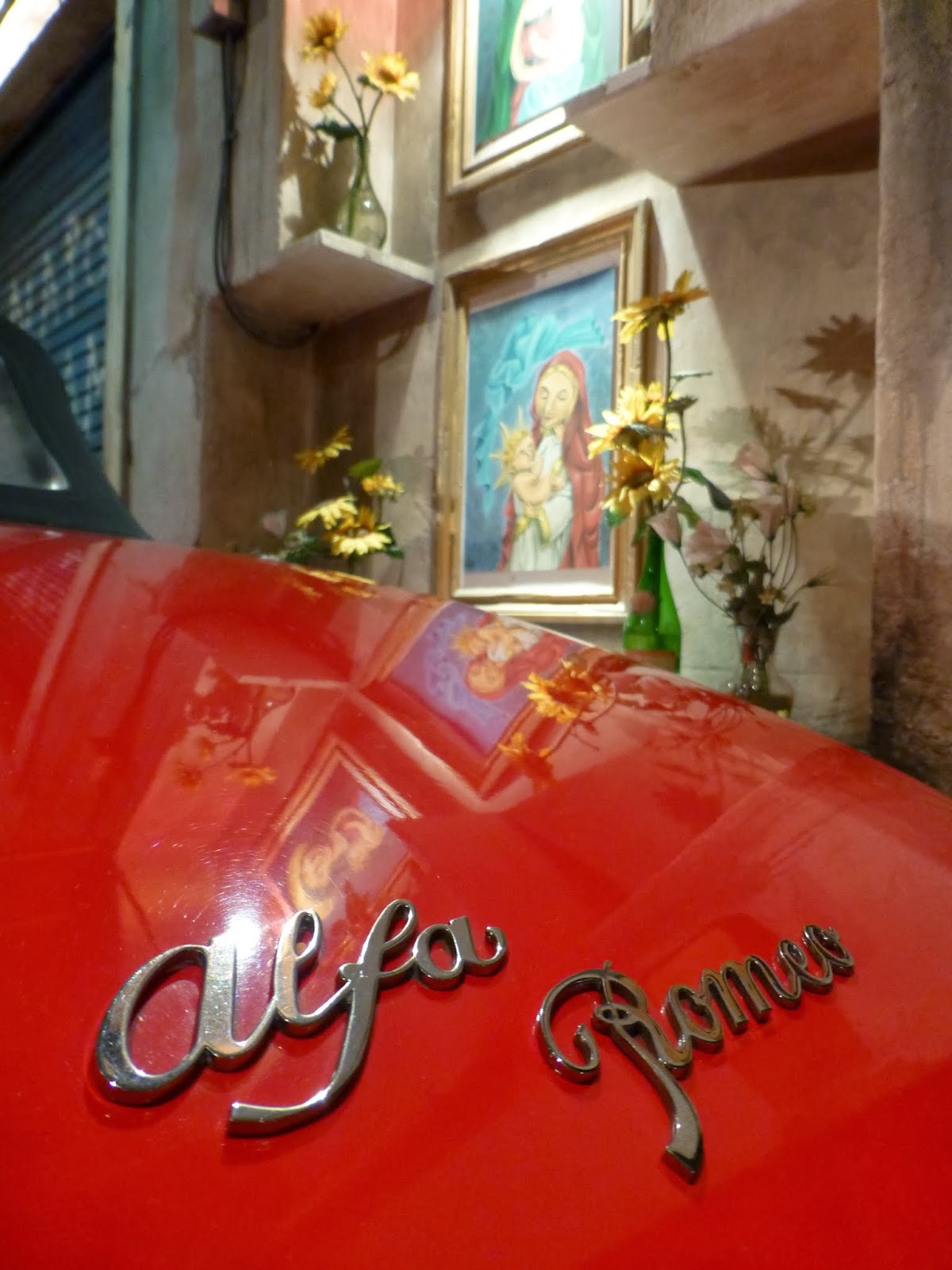
 Artsy hood logo shot.
 One of my favorite movies as a child was The Love Bug. I still have an affinity for VW Bugs; maybe someday I'll own one of these. I'd be happy even if it didn't run, just to use as a piece of furniture in what would need to be a very large living room.
There are several racing-related displays in the museum - a "pit stop", a full-size car mounted on a wall next to the souvenir shop and cafe, and plenty of racing models. Actually, there are hundreds of little toy cars and model cars in display cases in a couple hallways. There's also a large garage room that holds about a dozen more vehicles and a few other entertainment options, such as the ability to test drive cars.

I'll get to the other half of Tokyo Mega Web - on the other side of the mall - at some point in the future. The car museum is free and should be open daily from 11 AM until 9 PM. Some things (including the cafe) close earlier. The entire Palette Town mall complex has a lot to see, which, again, I'll post about sometime later.