A Gloomy Day at Deoksugung Palace, Seoul, Korea

 Across the street from Seoul's City Hall, the former center of politics in Korea can be visited and experienced, rain or shine. As you can see, my visit was on a gloomy morning.
 That didn't stop the royal guards from performing their changing of the guards ceremony nice and early in the morning! Entry to the palace is through this gate, called Daehanmun. Just beyond is a very wide bridge called Geumcheongyo, over which the king's carriage would pass when going to and from the palace.
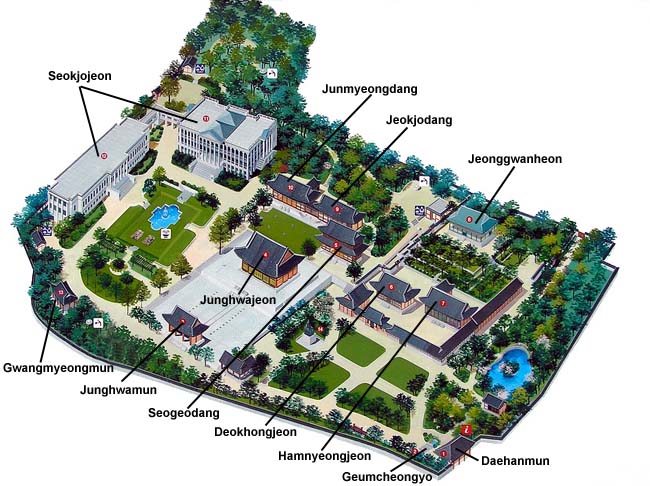
Here's a map from art-and-archaeology.com of the palace grounds, so you can reference locations when I mention them.
 The buildings around the grounds all served their own purposes.
 Inside, they're quite spacious. Walls can fold up to expand the spaces or provide for privacy.
 Some buildings are nicer than others, and the rooms which were used by the king are quite fancy.
 Unfortunately, I can't tell one building from the other. Perhaps that was done on purpose - Korean palaces are quite complex with a maze of different but similar buildings with several small courtyards and passageways. In fact, this palace might be the least complex as far as its layout. I believe this might be Deokhongjeon, one of the buildings where he would have taken care of daily business.
 There's a nice wall running through the middle of the palace grounds with several passageways; the outer wall is also noteworthy and similarly designed.
 Jeongwanheon, at the back of the grounds before passing through the wall, has quite fancy work along its facade.
 Here's a close-up.
 There is more open space in the true back portion of the grounds. Seokjojeon is a pair of buildings which now function as a pair of museums. They are obviously western designs, and one of them wasn't finished until after Japan began its occupation. The building you can't see, just to the right of the above image, was covered by scaffolding on my visit; it should now be reopened as a history museum, restored to its original glory and displaying original furniture.
 There's a European lawn/plaza in front of the two buildings, which sit at right angles to each other. You can see Junghwajeon on the other side of the fountain; Seoul City Hall is to the left in the distance.
 Across from Junghwajeon is a bell structure, called Junghwamun.
 And here is the front view of Junghwajeon. This is the main hall of the palace, where the king held his morning meetings to discuss politics. Most prominent is the king's throne.
 The stone work out front is fairly impressive, but inside is the highlight.
 Photography inside the building isn't permitted, but the throne is visible from outside. Here's a closeup of a portion of it.
And the full throne!

It snowed a lot on my first trip to Seoul, and it was quite cold, but this was possibly the ugliest day on my entire trip. Deoksugung is an important palace, that's certainly true, but the others scattered around Seoul are larger or more beautiful. It's worth seeing for the throne and the museums at the back of the property.

Tickets that include four palaces and Jongmyo Shrine can be bought for 10,000 won (about $10) and are the best value if you're going to see all of the palaces. Admission to just Deoksugung is only 1000 won (about $1).

The grounds are open 9:00-21:00, closed Monday. Take the subway to City Hall Station on Line 1 or Line 2, and use Exit 2, which puts you right in front of the main gate.

Junghwajeon is open only Saturday and Sunday, 9:00-16:00. Ceremonies for the changing of the guards are at 11:00, 14:00, and 15:30. (Note that I can't confirm this information on the Deoksugung website.)

English language tours are given Tuesday through Friday at 10:30, and Saturday (odd months) or Sunday (even months) at 13:40.

Seoul Museum of Art, Seosomun

 A short distance north of Seoul Station is the City Hall, seen above. It has its own subway stop, so you can just get off there.

Across the street from the plaza is a famous palace, but I'll come back to that after I visit the Seoul Museum of Art.
 My visit to the museum coincided with a Tim Burton exhibit. I didn't go to the exhibition, as I'm not really crazy for Tim Burton, though in retrospect I probably would have still enjoyed it.\
The main collection focuses on modern art, spread over three stories and six halls. Admission is less than $1, though special exhibitions (which can be really good) have their own fees.

Overall, the Seoul Museum of Art is enjoyable, and the main exhibitions are worth the minor admission fee. For those visiting the city on a limited schedule, it's worth the time only if you're a big modern art fan, and if you're visiting the palace across the street. Of course, an interesting temporary exhibition can make it that much better. There are several other modern art museums scattered across the city, but I wasn't able to visit any of them on my trips due to planning issues, though I expect that I'll make it to a few more on my next visit to Seoul... whenever that is.

CoCoIchi Curry Instant Udon: Is it as good as the restaurant?

I've mentioned CoCoIchi many times in the past. Most of my students know by now that I'm essentially addicted to the stuff, and I eat there about once a week. In fact, I just went there for lunch today (it's Friday night when I'm writing this post).

I almost always order the stewed chicken curry. But they also serve udon (a type of noodle soup) in curry form and various other dishes.
 The package is pretty large and you get a good full meal out of it, but still consume less than 500 calories. It's only a couple bucks - a bit pricier than some other instant noodles but still pretty reasonable.
 The dried udon noodlers are inside, plus three packets. There's a liquid soup packet, in blue, a clear package of dried toppings - mostly meat and onions, and the green liquid spice packet.

You add the dried toppings and soup plus hot water, and let it sit for a few minutes. Then, remove the rest of the lid, and stir. This is what you get:
Okay, it doesn't look terribly special. But it's pretty good. The distinct curry flavor is very obvious, and the spice packet gave it just the right kick. Yes, I'd prefer it to be even spicier, but then again curry is fine even in mild form.

I've never had CoCoIchi's curry udon but I'd say this is a pretty good match to their overall curry flavor. I prefer thicker curry, though, and this is a soup, so it's not quite my style. You can drink the flavorful broth once you finish the noodles, of course! I would be glad to have it again, in fact, if I ate instant noodles like this frequently!

How to Feel at Home While Living in Korea: Itaewon and Western Foods in Seoul

I've been living in Japan for two and a half years - in fact, I just passed the 30-month anniversary yesterday! I haven't been out of Asia in that time, and I certainly have had moments where I've been homesick.

One way to feel at home is to eat comfort food. I've managed to lose a good bit of weight (not enough, but still some) but it doesn't mean I can't have a bit of tasty goodness to remind me of home. I can cook some dishes and there are plenty of international restaurants in Tokyo, but some truly authentic foods are tough to find in Japan at a reasonable price.

Seoul afforded the opportunity to have some dishes I don't usually get in Japan, plus a few "Korean" versions of western food.
 Salsa runs about $6 a bottle and a four-serving bag of chips is about $3 in Japan. But for around $1, this bag of chips came with a good, spicy salsa sauce in the bag!
 Oreos are readily available and similarly priced in Japan and the US. But this purple ice cream flavored pack is only available in Korea, as far as I know! Other candies I've seen fairly often in Korea but not in Japan are Twix (caramel only - I've seen them once in Japan but many times in Korea) and Skittles (Sours were much more common than original style; there is no equivalent to this candy in Japan!).
 But snacks aren't healthy and for those who want something tasty and a bit more healthy, the neighborhood of Itaewon has almost every kind of cuisine available within a few minutes of the subway station.
 I found a Mexican restaurant that had some really good supreme nachos. These were priced quite reasonably (for a sit-down restaurant) and tasted delicious. Plus, they had a great hot sauce sitting on the table.
 There are plenty of bars and pubs with western beers, including a few craft breweries. Itaewon's nightlife is actually split into distinct areas, with a second area just north-east of the main drag. I had some awesome beers at one craft brewery and enjoyed a bunch of hot wings on their special night, where they were only about 40 cents each.
 Actually, Monday through Thursday there are one or two bars/pubs/taverns that have wing specials on any given night, and most of the bars have specials several days each week. Wings are awesome and on both trips to Korea I made sure to spend one night getting my fill of spicy poultry goodness.
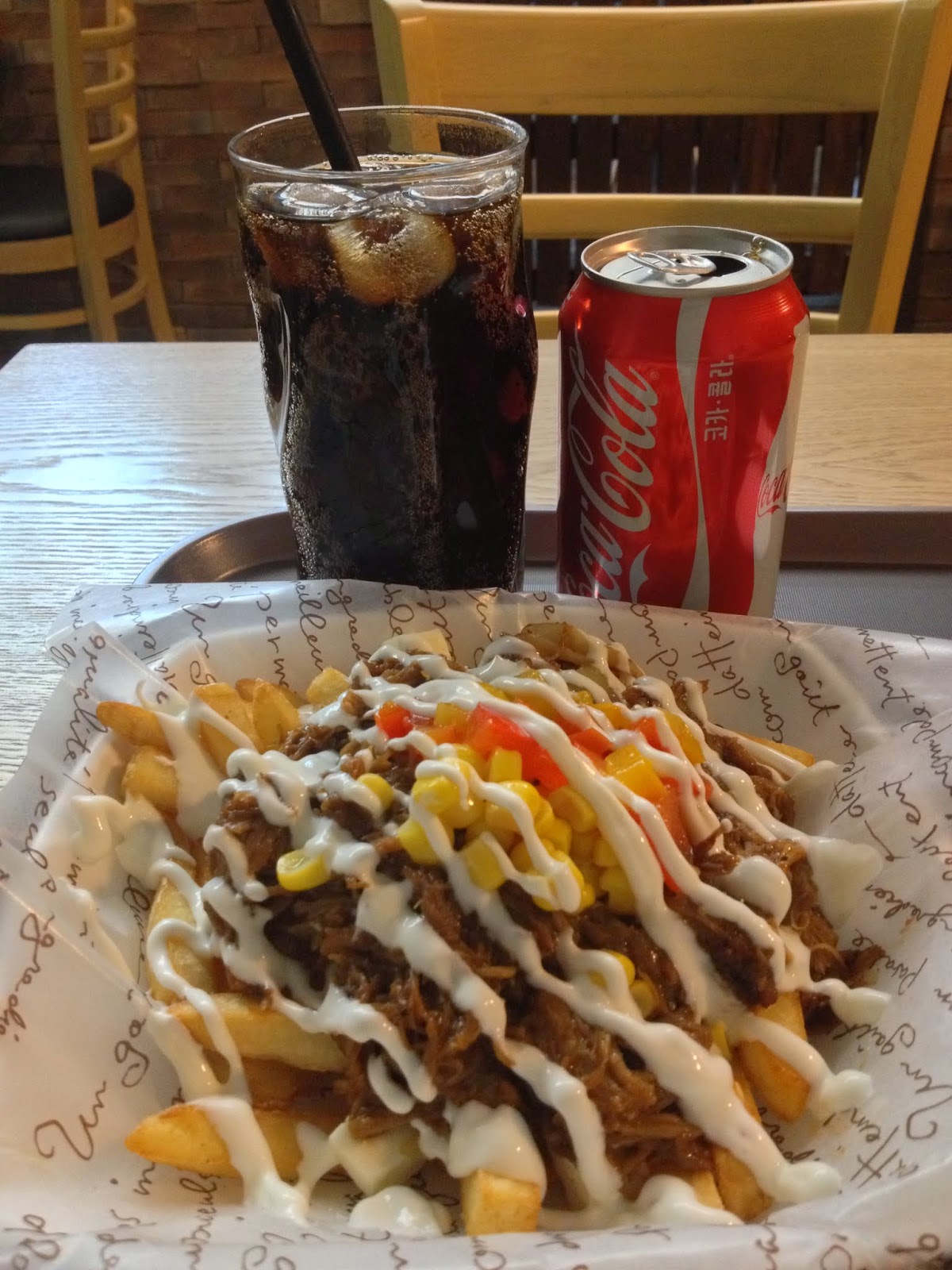
 Is it strange that Korea is the first place I tried poutine? It wasn't fantastically awesome, but I enjoyed it! There's also an Australian restaurant that sells different types of pies; that wasn't so great but it was good.
 So it's not the healthiest of foods. But there's something about Taco Bell that just makes me happy! McDonald's doesn't do that. KFC doesn't do that. There's a Taco Bell right next to Itaewon station and I'm a bit embarassed to say I've been there a few times (only once on my last trip, thank you).
 The hot sauce packets have Korean on them! Souvenir!
There are a few chain restaurants in the area, and I had a banana sundae at Baskin-Robbins one night. 
 Krispy Kreme and Mr. Donuts (a Japanese donut chain) can be found in Tokyo, but I was starving one morning and stopped into a Dunkin Donuts near Seoul Station. The little donut holes were pretty good...
 But this sandwich was the opposite of good. It was flavorless and not cooked all the way through. That's a shame, because it's like an Egg McMuffin that I love so much from America.
 Yes, when traveling to foreign countries, I do my best to sample the local cuisine. But sometimes I just have to get an American fix. And other times, I'm in a rush and need something fast and familiar. I've made it a resolution of sorts to try new food, though!

But we're speaking Japanese!

(Subscribers: Is this post in your feed twice? Sorry! I had a scheduling error.)

This video hit YouTube in May, and it's pretty funny.
While I'm hardly anything like the "foreigners" in this video - who are all native Japanese - this type of situation is something I've seen a few times when out with my Japanese friends.

They tend to communicate through the Japanese person and assume I don't know anything. Well, I don't know much at all, but my Japanese ability has really grown a lot lately.

I've walked into stores, restaurants, and sightseeing spots, and if I'm alone the workers frequently get nervous about having to use their English. The funny thing is, for every one that gets nervous or tries really hard to speak English (which I'm grateful for, don't get me wrong) there are two more who speak fluent Japanese to me at native speed.

Anyway, that's all!

Listening in Japan: Aizuchi

Micaela lives here in Japan and explains the Japanese "culture" of aizuchi.
I've actually picked up several of these thanks to my students and friends. I especially say hmm, uhn, and ehh. I haven't really started using any of the Japanese "true" words ("so desu ne", etc) though I certainly understand them at this point!

So if you ever speak to a Japanese person - or someone who's been here for a long time - don't be surprised by this!

Keeping Warm with a Korean Hot Pot

When I visited Seoul over the New Year holidays, it snowed three or four times in the week I was there. It was cold! After spending a day outside in Daegu, I found myself with about an hour's wait for my train back to Seoul.

The KTX station is spacious and full of restaurants, and I found one with something spicy to melt the frozen blood in my veins.
This set meal was just what I needed. The pot has a spicy chicken stew using the spicy red pepper paste found in so many Korean dishes. The side dishes are rice, kimchi, and something that I couldn't identify. That's a cup of tea behind the hot pot.

There are plenty of Korean dishes I still want to try, and many that I want to have again! I might need to make a trip to the Korean neighborhood in Tokyo to get my fill.