Sapporo is a great city. Hokkaido University and its botanical garden are very beautiful and peaceful escapes from the grid, and the Sapporo Beer Museum has some tasty food to go with its thirst-quenching fresh beer. There are baseball and amusement parks in the summer, and skiing in the winter. The island of Hokkaido has lots of nature including a volcano and two architectural museums - a historical village on the outskirts of Sapporo and the fantastic former prison in Abashiri. One last tourist area in Sapporo is Susukino, the nightlife area south of Sapporo Station. It starts a block or two south of Odori Park.
You know you're in Susukino when you reach its big intersection with bright neon and LCD billboards and screens. From this intersection the fun branches in all directions. I ate dinner once or twice at the tiny CoCoIchi curry restaurant at this intersection.
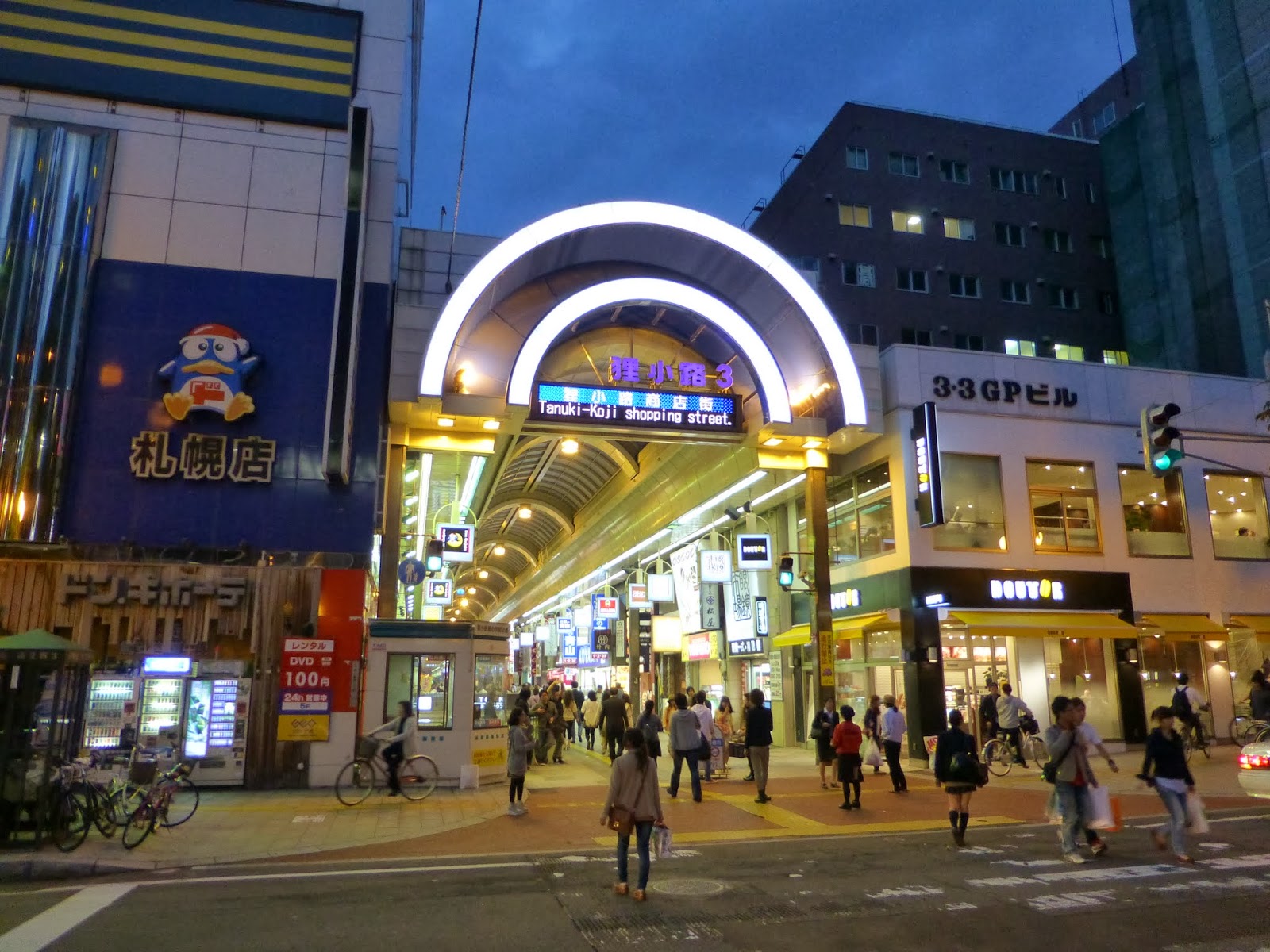
About one to two blocks north is a covered shopping arcade. Yes, that is a Don Quixote on the left with the penguin mascot.
There are restaurants, shops, and game arcades inside, and an underground shopping area along with the subway entrances.
Once you get into the side streets and alleys, you start to find the clubs. It wasn't cold in September, so during slow times some of the club girls would stand at the entrance. Usually only the male touts stand around outside begging for customers, almost like a freak show at a circus.
The options range from the usual karaoke boxes, hotels, restaurants, pubs and bars to dancing clubs, soaplands, and host/hostess clubs. If you don't know what those are, I'll leave it to you to find out for yourself.
During the peak times, this area is packed with drunk or looking-to-get-drunk businessmen, touts trying get customers, and of course some tourists. There is an area (Ramen Yokocho) with ramen shop after ramen shop which is very popular for those looking for local noodles. In February, some of the Sapporo Snow Festival is held in Susukino. And on top of one of the buildings is a large Ferris wheel that gives a good view.
While not officially a red light district (they used to exist in Japan but not anymore), I understand that some of the clubs still serve as fronts for prostitution. But that all happens behind closed doors and Susukino felt perfectly safe at all times. My hotel was in this district, which I talked about in a different post. Note that during the day, Susukino is quite lifeless, but pictures at night are much more difficult to take.
Sapporo Station is quite large, with a large mall inside JR Tower.
There is a lot of large open space here, some of which is used for events. During my visit, there was a summer festival in Odori Park and on the south side of the station. The mall inside the station is over several floors, and there's a BIC Camera adjacent to the mall.
The top floor of BIC has a Sapporo Ramen Museum, with an old fake steam train and themed buildings.
I'm not sure what god is housed at the ramen museum. Is there a God of Ramen?
The theming is generally made to look like 1950s-1960s streets.
My coworker highly recommended Ginparou, which was difficult to find because the picture she showed me was inside the restaurant, not the same as seen at the entrance. The sign above is at the entrance.
She told me she loved the traditional Sapporo-style ramen, to which I added a hard-boiled egg. It turns out she didn't explain quite enough what to order so I ended up with something different. That's okay - this was pretty good but I still think Kitakata and Kyushu styles are better.
Speaking of food, I tried to find as much variety as possible on this trip. There are several dishes and agricultural products that Hokkaido is known for, so I went for everything I could. While not really Hokkaido-specific, I found a cookies and cream flavored Pocky called Pocky Panda. It was pretty good! I don't really follow Pocky flavors like I do Kit Kat, but I buy unique flavors here and there.
I also grabbed a bag of Japanese Cheetos. These are triple-cheese flavored "Su-Kon" or something like that. Now, Cheetos do exist here, too, but these were pretty good, but mild.
And speaking of dairy, Hokkaido is where Japan's milk comes from. I can buy Hokkaido milk in my local convenience stores and supermarkets, but this bottle had the freshest, most delicious milk I can ever remember having. And I kept the bottle. Not a bad deal for less than $2 (maybe it was as cheap as $1).
As I described in my post about the beer museum, barbecued/grilled meat - actually, mutton (Genghis Khan), is Sapporo's most famous dish. At the summer festival, I saw a lot of booths selling the usual Japanese and western foods (gyoza, takoyaki, corn dogs) but one somewhat-popular stall had grilled meat. This was beef but it was good anyway, and it came on a bed of shredded cabbage. It went well with a can of beer.
I bought two cans, with different labels (they are different kinds of beer). I'm not sure if these are limited cans for an event or if Sapporo always makes Fighters beer. I was very happy that both empty cans made it home safely.
While this looks like an American food - and it is - the french fries were made with Hokkaido potatoes. Made fresh, they were pretty good, but not outstanding.
Any Japanese person who tells you about Sapporo sightseeing will mention the White Lovers chocolate candies. They're actually white chocolate cream in between two biscuits, similar to Milano cookies from Pepperidge Farm. I've had those before and they're pretty tasty, but this white chocolate drink from Ishiya really took the cake. It's very sweet and flavorful, but not overpowering. It doesn't come cheap - each tiny can runs about 200 yen, but I still drank about half a dozen of them on my trip.
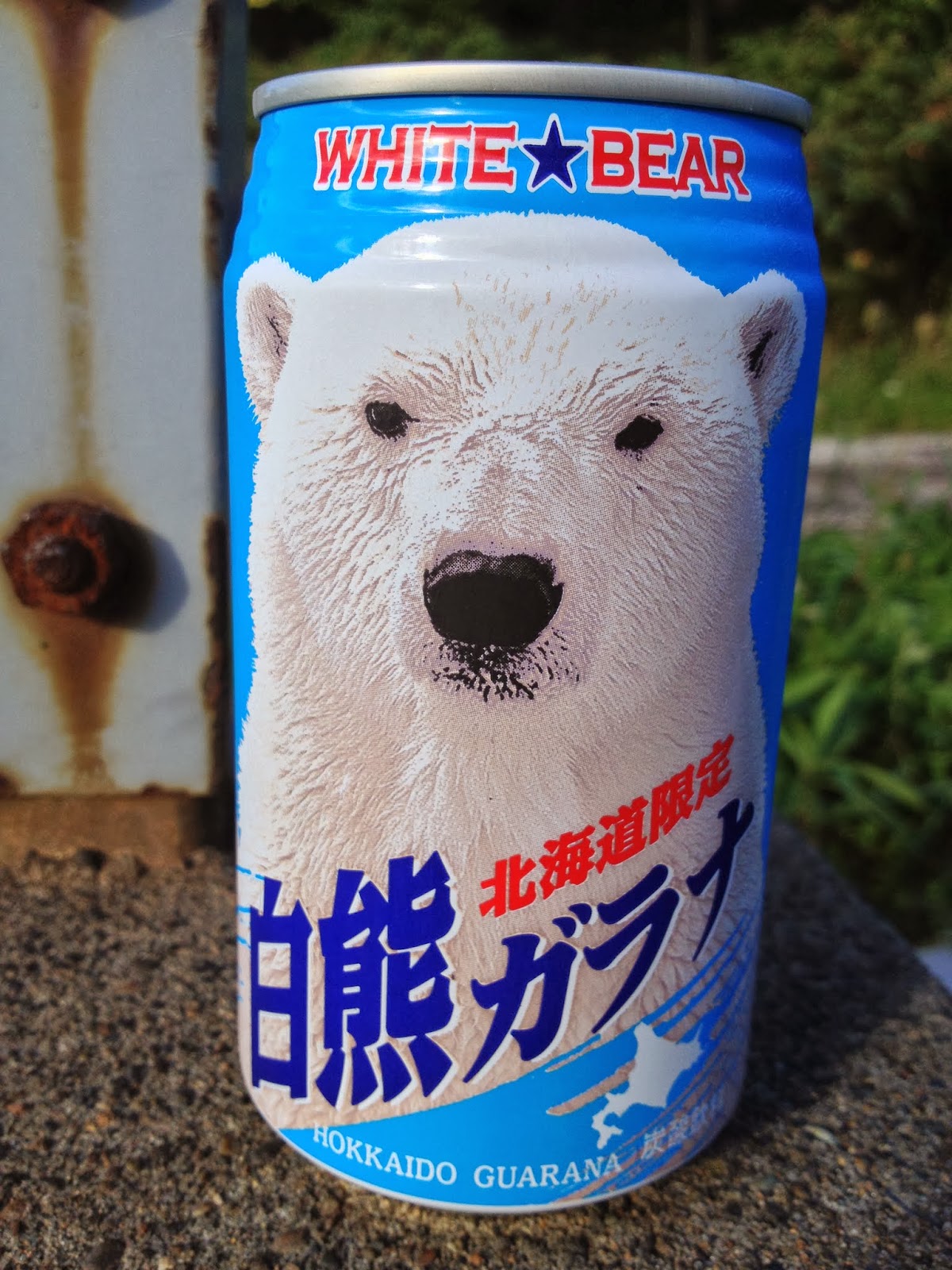
Hokkaido has its own sodas, too. There is a White Bear and a Brown Bear - the white version is a guarana soda which isn't very sweet and has a decent guarana flavor. The brown version is more of a cola, I think.
Finally, there are several microbreweries in Hokkaido in addition to the Sapporo brewery. Abashiri Brewery has a few styles of beer, including this Okhotsk Blue. I'm not really sure what it's suppsoed to taste like, but it was crisp and flavorful while I was drinking it. I suppose I could say it tasted blue. There is a hint of some kind of flavor or something in it that I just couldn't place. Unfortunately, it left a slight oily aftertaste in my mouth. There are several other craft and microbreweries in Hokkaido, and on a return trip I plan on trying a bunch of them.
Hokkaido is known for other foods - sea urchin, hairy crab, squid, salmon roe, and scallops are supposedly great here. Because of the milk/dairy industry, there are also Hokkaido cheese, butter, yogurt, and ice cream. Fruits and vegetables include corn (sometimes sold at tourist locations grilled on the cob), onions, and melons. Yubari melons are extremely expensive but very sweet - they are similar to cantaloupes. Note that lots of Hokkaido produce and dairy products can be bought in supermarkets across Japan. In addition to Sapporo's miso broth ramen, Hakodate has salt based broths and Asahikawa uses soy based broths.
Finally, not exactly a Hokkaido thing, but in one of the crane games in Susukino I saw this - Vocano. It's Uno, but with anime girls on the cards. I've seen themed Uno decks before, but I'm pretty sure this was a knock-off. I wish I had played and won a deck now because I've never seen them before or since. I have Japanese Uno cards, and these are styled exactly like the official game.
A return trip to Hokkaido for me would include sampling more local beers, having Genghis Khan and trying more ramen, visiting the Historical Museum of Hokkaido and the architectural museum, another Fighters ballgame, and going back to Abashiri and Shiretoko for some nature, ice walking, and boat cruises. A budget airline makes visiting Sapporo for the weekend quite cheap, so it's possible I can make a return trip in a few months.
Showing posts with label Sapporo. Show all posts
Baseball in Hokkaido: Seeing the Nippon Ham Fighters at Sapporo Dome
Is that a UFO in the distance? Nope, it's the Sapporo Dome, home of the Hokkaido Nippon Ham Fighters. On September 21st, I saw them face off against the Golden Eagles.
As far as domes go, it's pretty nice. There aren't really any standout features inside, but there is a walkway that I'm pretty sure goes all the way around the stadium and you can see the field the entire time.
It was a Saturday , which means everybody went to the ballpark. There was an increased interest in this game, because the Golden Eagles' ace, Masahiro Tanaka (maybe you've heard of him?) was starting.
Due to the crowds, I decided not to attempt to circle the stadium. I hope to return to all the NPB stadiums in the next year or two and hopefully explore a little better.
There are a couple giant baseballs in the outfield stands.
This is the view from my seat looking out towards center field. Despite having a fairly inexpensive ticket I lucked out and got one of the closest seats in my section. I was certainly happy with my location; this is the closest I've been to the infield at any NPB game.
The stadium is designed for both baseball and soccer. The stands and wall open up and shift around, and an entire real-grass soccer turf can be rolled in and out of the stadium.
You can see the wall separating my section from the more expensive tickets; I was only a couple rows back from this. Notably, NPB ballparks do not have a lot of luxury boxes.
Game time. The Eagles dominated the game, led, of course, by Tanaka. The Fighters actually scored first, but Rakuten always seemed to have runners on base; the Fighters made three errors in the game. The final score was 7-3 in favor of the Golden Eagles, and Tanaka got his 22nd victory of the season.
Here's a shot of the scoreboard and starting lineup before the game.
This blimp flew around the stadium before the game and between innings.
Food choices were relatively limited to the usual Japanese ballpark fare. I found a booth selling mixed drinks and beer which had a couple interesting choices. The fried chicken was really good.
The packaged thing is some form of rice snack, though I forgot the name. The rice was really good and it was wrapped in chicken or something like that, and there was some sauce on the outside. I've never seen this before or since, but since I don't know what to look for that doesn't surprise me.
Like many other Japanese teams, the Fighters do a balloon release in the middle of the 7th inning. Even though I've seen it several times before, it's still fun to watch.
Tanaka is a righty, so I couldn't test my camera with him. But I took a couple shots of Yoshikawa, the Fighters' pitcher.
What do you think? Baseball card-worthy? They seem a little dark, and they're a bit grainy at full size.
Andruw Jones was a part of the Golden Eagles last year. He batted .243 with 26 home runs.
There's a small museum in a passageway outside the ticket gates. Sapporo Dome has hosted some big concerts over the years, and one case had memorabilia from mostly western bands.
There were soccer things too, but baseball is the stadium's main use, so the cases had lots of memorabilia from various events at the Dome. This is an exhibit on a Japan-Cuba match held at the stadium in November, 2012 - the Nagashima jersey is autographed.
The NPB All-Star Game made its way north in 2001. I'm guessing that each signed card is from a different team.
Okoso was the first owner of the Fighters. By the way, the Fighters are owned by Nippon Ham, a meat company that is obviously still doing quite well. The team does not fight ham. Okoso is the first owner to be honored by having a jersey number retired, and was the first jersey number retired by the Fighters - he was elected to the Japanese Baseball Hall of Fame in 2009.
The rest of the baseball display focuses on active stars and equipment.
Atsunori Inaba has been with the Fighters since 2005, but started his career in 1995 with the Swallows. He's put up some decent numbers in Hokkaido and reached 2000 hits in 2012, though he is nearing the end of his career, as he is now in his 40s.
I've mentioned it before, but this game had a big significance for me - it was the 12th NPB game I saw in Japan, at the 12th different stadium. With 12 teams in the league, it marked the completion of one of my major sightseeing/hobby goals in Japan! I'd like to see games at as many minor league stadiums as possible now, but I'd also like to revisit the stadiums and do more exploring. We'll see what 2014 holds for me in terms of baseball - there's also a trip to Korea coming up in April/May!
The stadium is easy to get to - the Tono subway line gets you pretty close to the park; the subway ride from Sapporo Station is 13 minutes and it's a 10-12 minute walk from Fukuzumi Station to the Dome itself.
As far as domes go, it's pretty nice. There aren't really any standout features inside, but there is a walkway that I'm pretty sure goes all the way around the stadium and you can see the field the entire time.
It was a Saturday , which means everybody went to the ballpark. There was an increased interest in this game, because the Golden Eagles' ace, Masahiro Tanaka (maybe you've heard of him?) was starting.
Due to the crowds, I decided not to attempt to circle the stadium. I hope to return to all the NPB stadiums in the next year or two and hopefully explore a little better.
There are a couple giant baseballs in the outfield stands.
This is the view from my seat looking out towards center field. Despite having a fairly inexpensive ticket I lucked out and got one of the closest seats in my section. I was certainly happy with my location; this is the closest I've been to the infield at any NPB game.
The stadium is designed for both baseball and soccer. The stands and wall open up and shift around, and an entire real-grass soccer turf can be rolled in and out of the stadium.
You can see the wall separating my section from the more expensive tickets; I was only a couple rows back from this. Notably, NPB ballparks do not have a lot of luxury boxes.
Game time. The Eagles dominated the game, led, of course, by Tanaka. The Fighters actually scored first, but Rakuten always seemed to have runners on base; the Fighters made three errors in the game. The final score was 7-3 in favor of the Golden Eagles, and Tanaka got his 22nd victory of the season.
Here's a shot of the scoreboard and starting lineup before the game.
This blimp flew around the stadium before the game and between innings.
Food choices were relatively limited to the usual Japanese ballpark fare. I found a booth selling mixed drinks and beer which had a couple interesting choices. The fried chicken was really good.
The packaged thing is some form of rice snack, though I forgot the name. The rice was really good and it was wrapped in chicken or something like that, and there was some sauce on the outside. I've never seen this before or since, but since I don't know what to look for that doesn't surprise me.
Like many other Japanese teams, the Fighters do a balloon release in the middle of the 7th inning. Even though I've seen it several times before, it's still fun to watch.
Tanaka is a righty, so I couldn't test my camera with him. But I took a couple shots of Yoshikawa, the Fighters' pitcher.
What do you think? Baseball card-worthy? They seem a little dark, and they're a bit grainy at full size.
Andruw Jones was a part of the Golden Eagles last year. He batted .243 with 26 home runs.
There's a small museum in a passageway outside the ticket gates. Sapporo Dome has hosted some big concerts over the years, and one case had memorabilia from mostly western bands.
There were soccer things too, but baseball is the stadium's main use, so the cases had lots of memorabilia from various events at the Dome. This is an exhibit on a Japan-Cuba match held at the stadium in November, 2012 - the Nagashima jersey is autographed.
The NPB All-Star Game made its way north in 2001. I'm guessing that each signed card is from a different team.
Okoso was the first owner of the Fighters. By the way, the Fighters are owned by Nippon Ham, a meat company that is obviously still doing quite well. The team does not fight ham. Okoso is the first owner to be honored by having a jersey number retired, and was the first jersey number retired by the Fighters - he was elected to the Japanese Baseball Hall of Fame in 2009.
The rest of the baseball display focuses on active stars and equipment.
Atsunori Inaba has been with the Fighters since 2005, but started his career in 1995 with the Swallows. He's put up some decent numbers in Hokkaido and reached 2000 hits in 2012, though he is nearing the end of his career, as he is now in his 40s.
I've mentioned it before, but this game had a big significance for me - it was the 12th NPB game I saw in Japan, at the 12th different stadium. With 12 teams in the league, it marked the completion of one of my major sightseeing/hobby goals in Japan! I'd like to see games at as many minor league stadiums as possible now, but I'd also like to revisit the stadiums and do more exploring. We'll see what 2014 holds for me in terms of baseball - there's also a trip to Korea coming up in April/May!
The stadium is easy to get to - the Tono subway line gets you pretty close to the park; the subway ride from Sapporo Station is 13 minutes and it's a 10-12 minute walk from Fukuzumi Station to the Dome itself.
Hokkaido University Botanical Garden in Sapporo
I think I have some new favorite photos.
Situated on the other side of the tracks from the current campus of Hokkaido University, a surprisingly large botanical garden provided the environment for me to practice my macro photography skills, and when the sun finally poked its way through the clouds, I took some fantastic shots.
Once entering the garden, following the path to the right leads to this building. I wasn't sure what it was at first, but I ventured inside......to find a Northern Peoples museum. There are artifacts including clothing, tools, and daily wares, plus some information and videos about how Hokkaido's natives lived their lives.
Turtles and bears were hunted by the tribe/village people, and turtle skulls were important. One of the videos showed what would be quite controversial today - bear hunting.
There are some other buildings in the garden. Most of them have displays. This one was largely empty, though.
The displays are limited to the first floor, and seem to focus on a couple important people in the garden or university's history.
I'm sure the rest of the house is beautiful, but as you can see it's off-limits.
There are some farm-like areas to the garden, but it's mostly laid out in a way that serves as a pleasant place to take a stroll.
There is some wildlife around here. I don't know anything about paw prints, but this could be a stray cat or a fox.
This small pond is a glorified puddle, but it has a nice bridge going over it, and the ivy was pretty nice.
While following a loop around the grounds will let you see pretty much everything, there are a few highlights in the middle of the garden.
This tree had some interesting knots.
Macro practice. I took these photos in a garden area that was laid out in rows, like a farm.
At this point in my walk, the sun started to show itself, and shadows began forming on the ground.
The trees here are pretty interesting.
Another pond. This one was larger, and covered with some sort of water plant. A bunch of seed pods for some form of plant lined the edge of the pond.
The next major area was an herb garden, with a grape vine for good measure. Right next to the herb garden was a rose garden; many of the roses were in bloom when I visited. The sun fully came out when I was at these gardens, and a couple of the rose pictures below have joined my favorites.
Stepping out from the beautiful rose garden, I came across a group of buildings.
I'm not sure if they're used anymore or just kept for historical purposes. The nice white building in the last photo has another museum on the first floor.
The museum contains stuffed animals that I believe are all native to Hokkaido. Some of the specimens are very lifelike.
There are dozens of mammals, birds, and fish displayed in several large cases.
The monkeys are eerily lifelike. And Rocky makes an appearance, though Bullwinkle is nowhere to be seen.
Leaving the buildings, my next stop was a rock garden.
There are several evergreen trees here, as well as some plants that thrive in rocky environments.
Beyond that, there's another small pond and rocky hill with more plants. This seems to be set up as a sandy area:
There is a well-disguised path that leads up and through this garden.
The largest pond is almost a lake. There's a greenhouse beyond it.
A very content dragonfly was resting on the bridge's handrail. He didn't mind at all as I tried to get a good picture of him; it was very difficult trying to get focus on his head.
Several dragonflies were buzzing about here, though. It's another beautiful area in the garden. And inside the greenhouse, I found some of the coolest looking plants I've ever seen. Though I suppose I have seen most of them at other gardens before.
This thing looks plastic.
The Harry Belafonte song mentions the deadly black tarantula hiding in banana bunches, but there's a yellow banana on this tree hiding something else.
That is a cockroach. There were a few more inside; the banana was yellow because it had become food for some insects and was slowly ripening toward rotting.
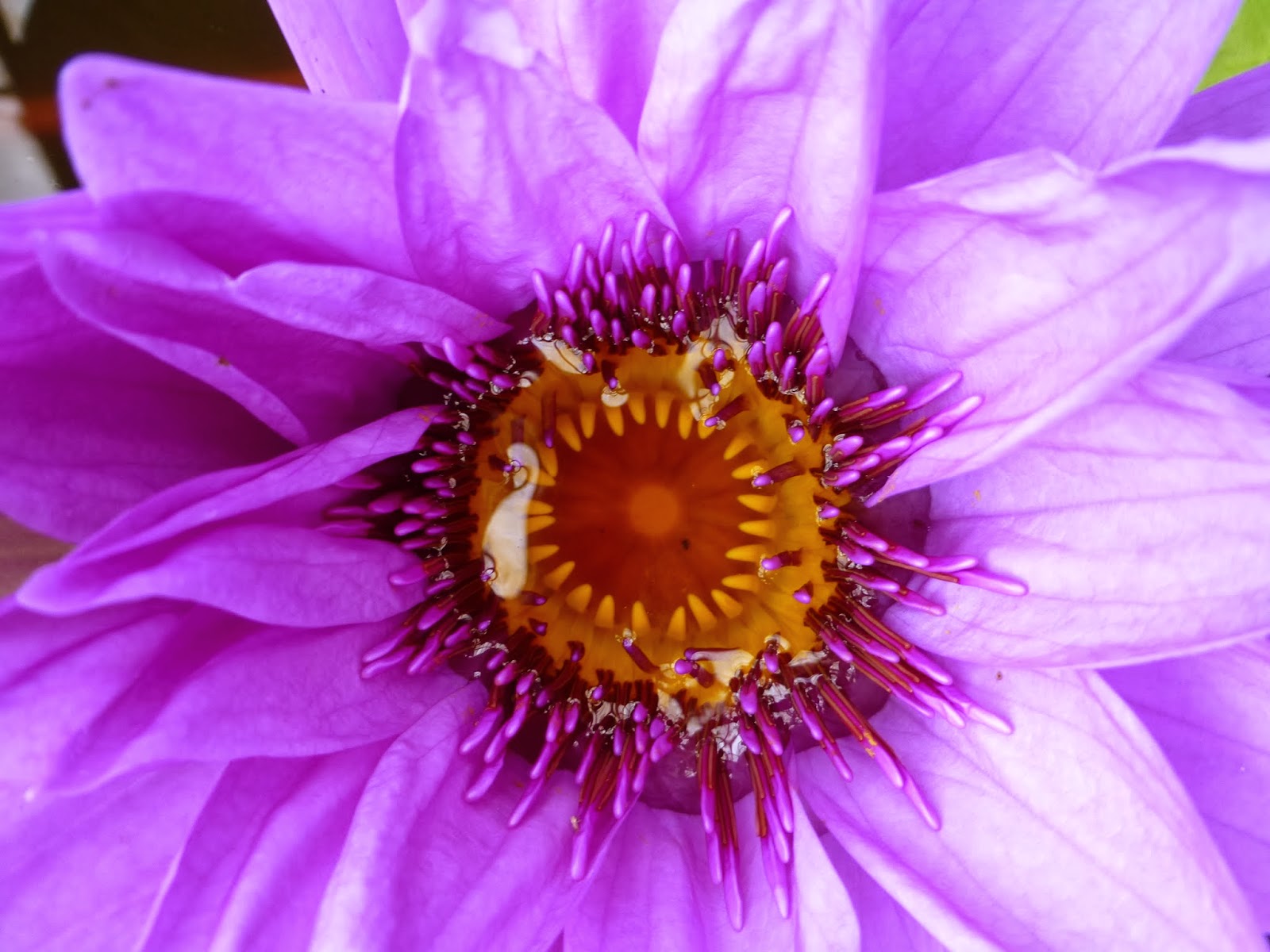
The greenhouse has a pond with some lillies (or whatever these are).
Open flower. Closed center.
I really love the colors of these close-up shots.
This flower is fully open.
The middle of the flower has water. I wonder if it's designed to catch bugs. There are several carnivorous plants in the greenhouse.
The two carnivorous plants I can easily recognize are pitcher plants and Venus fly traps.
I peeked inside the pitcher plants and all of them had at least a little food. So while the insects might get their fill of bananas, the plants get their revenge in the end.
Pitcher pictures. There were several species on display.
My last stop in the greenhouse was the cactus garden. Despite starting with a full charge, my camera battery was nearly drained by the time I got here after about four hours of exploring and photography. Thankfully, this was also the end of my tour around the garden.
In addition to being a great place to take a stroll and take photos, there are several lawns and places to enjoy a picnic. The botanical garden is 10 minutes southwest on foot from Sapporo Station, and it's open 9:30-16:30 (until 16:00 October and November) from very late April to very early November. Admission is 400 yen. The greenhouse only is open the rest of the year with limited hours; admission during this time is 110 yen.
Note that the website (Japanese) for the gardens states the building with the preserved animals until this summer as it is earthquake-proofed.
Subscribe to:
Posts (Atom)