Okayama Castle: The First Visit

 Okayama Castle is one of the most beautiful (reconstructed) castles in Japan, if not the most beautiful. Also known as "crow castle" due to its black exterior, it's situated right on a river leading out to the Seto Inland Sea, overlooking the beautiful Korakuen Garden.
 The original castle was destroyed during World War II, and the existing structure was finished in the 1960s. Only one original building remains, but foundations of old buildings and reconstructions help give a bit of an idea of what the former castle looked like.
 Some building layouts are identified by stone. There is at least one place where you can go "underground" to see the layers of trash and remains piled up on the castle grounds. Castles frequently burned down or were destroyed, and new ones would be built right on top.
 The castle is modern and well-kept, so exterior decorations shine in contrast to the black surface of the keep.
 The inside has a bunch of exhibits on several levels, but you can start at the top to see the view. First, there are the outlines of some structures in the area outside the castle.
 Looking off in other directions, you can see Korakuen just across the river, and the pedestrian bridge between the two.
 The exhibits are mostly standard, with some interactive ones. Actually, as far as modern castles go, Okayamajo is one of the best due to comprehensiveness.
 In addition to the usual armor and swords, there are a bunch of traditional toys and exhibits on city life, including a pottery-making class!
 Besides the exhibits, you can get a snack and pick up some standard souvenirs in the ubiquitous gift shop.
Okayama Castle is easy to get to. Walking from Okayama Station will take about 30 minutes - just walk straight east following the tram tracks, and continue heading east when the tracks turn. You can save a little time by catching that tram and getting off at Shiroshita Station, and again walking straight east for about 10-15 minutes.

The castle is open 9:00-17:30 (closed Dec. 29-31) and admission is only 300 yen. There are different combo tickets available, but you'll probably at least want the 560 yen ticket that also includes Korakuen Garden. There are some special exhibitions where tickets are 800 yen, and combo tickets aren't available.

Shikoku: A Few Sights (not Sites) in Shikoku

 I snapped a few shots in Shikoku that have no real good place elsewhere, so I've combined them together here.
Let's start with this single-car diesel train I saw in Takamatsu. It's not often that someone living in Tokyo gets to see a single car train, and everything around here is electrified. I've been on a few diesel lines in Japan, but there aren't too many remaining. And one-car trains are pretty tiny when you think about the huge eleven-car trains that arrive every two to three minutes on the Yamanote Line.
 Art. There's a bowling alley in the background.
 The chicken is a mascot called Bary-san from the town of Imabari. He is holding a ship and has a crown that looks like the Shimanami Kaido, a toll road which is a series of bridges connecting Shikoku and Honshu via Imabari. Shimanami Kaido is the only route to Shikoku which is possible to be walked or biked, and is on my itinerary for some unplanned future trip. At 70 kilometers, it'll be quite a bicycle trip so I won't be taking it lightly.

I'm not sure what AKB48 is doing in Shikoku, but I don't know how I missed the girl in the costume standing at the far left. I wonder what she was doing there too. Both photos above were taken at Matsuyama Station.
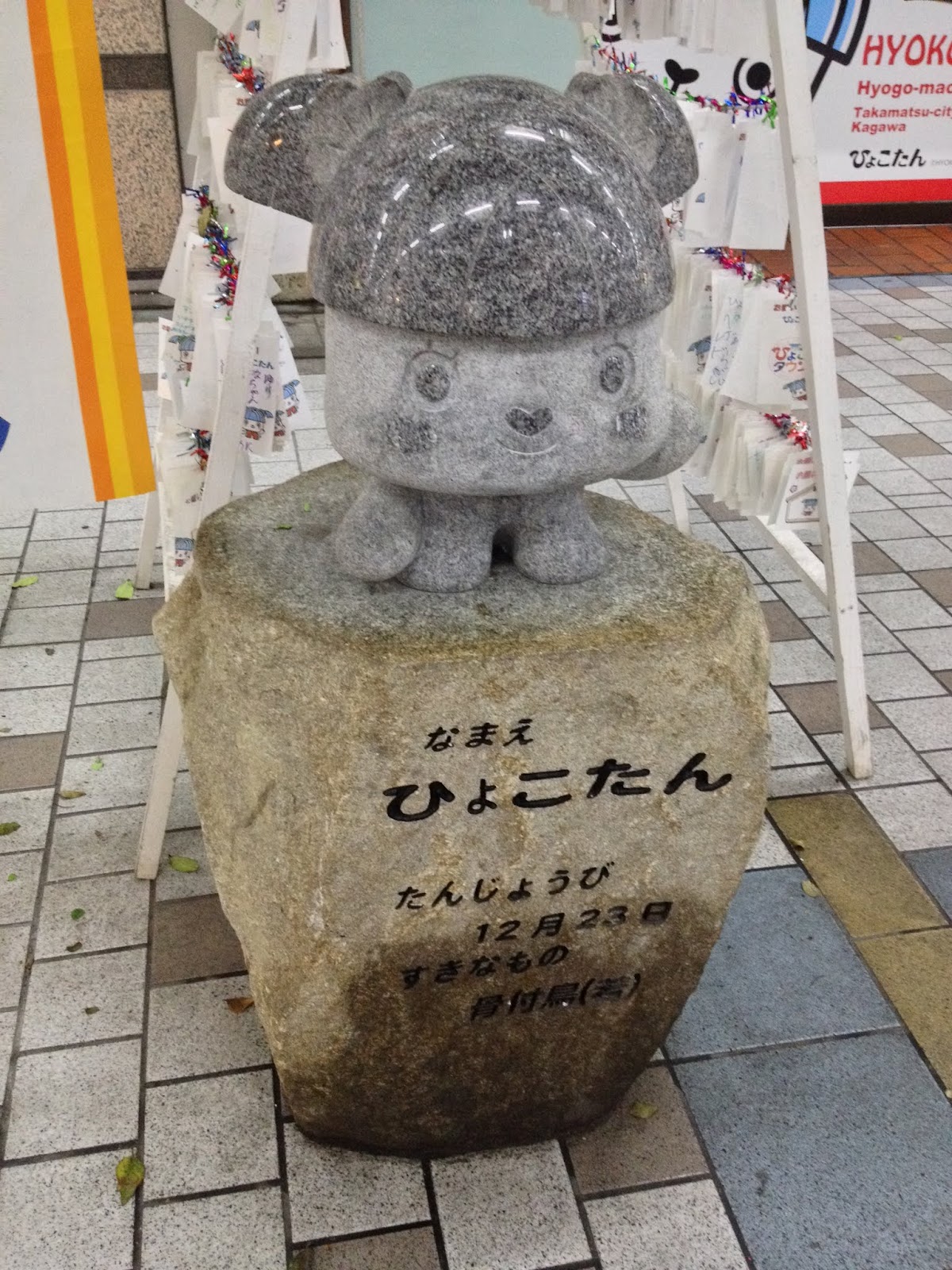
Finally, here are two pictures of Takamatsu's mascot "Hyoko-tan". Well, I say Takamatsu's mascot, but really she's the mascot for Hyogo-machi, the covered shopping street in Takamatsu. It's quite a long shopping street (like most others in Japan) and is a good place for tourists to get noodles and souvenirs and kill some time out of the hot sun or rain. I stayed at a hotel just off of Hyogo-machi so I used it as my walking route back to the train station.

Shikoku's Anpanman Torokko Green Car

 Last year, while heading off to some corner of Shikoku or another, I happened upon one of the Anpanman train cars. Apparently, there are three, traveling around Kagawa, Kochi, and Ehime.
 The outside of the train car is well-decorated with Anpanman characters, including special windows. The regular train windows are much larger than normal carriages, allowing a better view out for tourists - especially the little preschool ones the Anpanman TV show is geared toward. Not to mention they are actually open to the outside, which necessitates the safety bars you see in my photos. There are also shadowbox-style windows inside and outside the train with little Anpanman scenes.
 Apparently, the Anpanman train car above only seats twenty, with some seats in groups of four and others only in pairs. Again, the insides are custom with Anpanman images along the upper wall, the picture windows, and wooden seats complete with decorative Anpanman character coat knobs. The picture below shows some of the play "room" area for the little ones.
It appears that there is an indoor train car for use in Kagawa as well (no open windows), with drop down tray tables and nice seats. I didn't see this one - it might be used on one of the other routes, or just used in bad weather. I should note that the Kochi and Ehime train cars all appear to be "indoor" only and they do run to Okayama.

In addition to train rides, you can get special Anpanman breads and bentos (lunch boxes) along with plenty of exclusive merchandise. The train cars run various routes - the one that travels around Kagawa departs from Takamatsu in the morning before running two round trips between Tokushima and Awa Ikeda.

Trains run July through September, though not necessarily daily. JR Shikoku has a special Anpanman Train website, but it is all in Japanese and uses images for all of the text so nothing is translatable through Google. Seat reservations are available a month in advance and if you want to ride in the car above, I suggest doing it as soon as possible to avoid sellouts. As far as fares are concerned, the car you see above is considered a "Green" car and appropriate upcharges are applied. Advanced reservations are probably not required (they are available) for the regular Anpanman trains that run from Okayama to Kochi and Ehime - that is, unless you're traveling during holiday season.

Happy Fourth of July! Japanese Snacks for an American Summer

Summer in Japan isn't really much different from summer in America. Where in the US everyone takes July 4th off to grill out and watch fireworks, Japanese towns and cities have differing dates for local festivals and fireworks shows. The festivals are similar to old-style American town fairs, with food stands, kid's games, and various events. The only thing missing is the carnival midway!

With summer here comes summery drinks. But first, some things to snack on:
These are "Hot and Sour Tacos" flavored Doritos. They've got a nice kick and a good bit of sourness similar to sour cream or vinegar. I shared the bag with my coworkers and everybody enjoyed them! They're probably quite limited like the other Doritos special flavors.
I'm sure you can guess what these are. Watermelon is a summer luxury here (they don't come cheap!) but you can find watermelon-flavored candies in hotter months. One popular ice cream manufacturer makes really good watermelon-flavored bars with chocolate "seeds" inside. And these little chocolates taste like watermelon too, though it's a fairly mild taste.
After snacking, you're going to want something to wash it down. Last year, it seemed like yuzu (a lemon-like citrus fruit) sodas and drinks were everywhere. They are back again this summer, as is melon soda. But something that I grabbed just a couple days ago for the first time is this "Blue Hawaii Float" soda. Made by Pokka Sapporo, it's part of the Gabunomi drink line. The other flavor I regularly see is melon float (if you look at the logo on Kanna Hashimoto's shirt, you'll see it's green to match the melon soda bottle). Blue Hawaii tastes like... blue. Sweet, but with no really distinct flavor. Perhaps cotton candy, or bubble gum. It's good, at least for kids!

This summer, there is one set of drinks I want to find. Ramune is a soda like Sprite, sold in glass bottles with glass stoppers and is fairly unique to Japan. I see the usual flavors fairly often here, but there is an entire rainbow of colors and flavors sold across the country. I'm hoping I can find at least a dozen different flavors in the next few months... I guess I'll be stopping at the kid's snack shops and souvenir stands as much as possible!

Boy, could I go for some grilled sausages or steak, a chili cheese dog, and a Fritos pie now.

Happy Fourth of July!

Tokyo SkyTree: Inside the Base

Don't expect any cool behind-the-scenes photos here. Actually, I only have two photos for this post.
Tokyo SkyTree is Japan's newest and most visible man-made landmark. You can see the thing from all over Tokyo and beyond with clear weather, and it's highly popular with foreign and domestic tourists alike. When something makes the "must-see" list in Japan, everybody goes. (See also: Disneyland, Mount Fuji, Kyoto, and Hiroshima's A-Bomb Dome.)

While the prior generation Tokyo Tower remains standing and still draws its own share of tourists, that development was more for TV purposes, with only a small shopping/dining area found beneath. SkyTree was heavily planned to generate as much revenue and tourist interest as possible regardless of the weather, so the 10-ish floors found at the base have more than just a couple restaurants and souvenir shops.
Like fresh fruit (in plastic packaging) vending machines.

Actually, the first three or so floors of the complex serve as a standard shopping mall. There are the usual clothing and accessories stores, the usual mall restaurants, and so on. There's a Disney Store and a store for Studio Ghibli. There do seem to be more shops selling souvenirs, though the fourth floor is designated specifically for souvenirs. Next to the McDonald's, we found a store for one of the major TV studios with all sorts of goods relating to many of the popular Japanese TV shows. 

There's also a popular aquarium, a planetarium, and the relocated (and refocused) Postal Museum Japan. Many restaurants are found on the sixth and seventh floors.

Granted, if you come to SkyTree, you're probably coming for the view. But you can also plan on the museum and aquarium, and if the weather isn't so good the food souvenir areas are worth a stroll to try a bunch of traditional Japanese snacks.

Shikoku: The City of Kochi

 Kochi is a small, quiet city. It's about as far off the beaten path as big cities can go. A single transportation route from Kagoshima at the southern end of Kyushu up to Aomori and even Sapporo and Wakkanai at the northern tip of Hokkaido can be drawn. It runs through almost every important city in Japan - Kagoshima Fukuoka, Hiroshima, Okayama, Himeji, Kobe, Osaka, Kobe, Nagoya, Yokohama, Tokyo, Sendai, Morioka, Hachinohe, Aomori, Hakodate, Sapporo, and finally Wakkanai. Shikoku doesn't figure in that route at all, and far off that line is Kochi.

It is a coastal town, though, and as such could be reached by ships traveling north and south traveling through the Pacific Ocean. And today, it remains quiet and fairly isolated, with a fairly flat main area.
 One thing I noticed very quickly was Anpanman. Kochi is home to an Anpanman Museum, and the streetcar at the top of this post and these benches near the main train station are a constant reminder of that fact.
 Kochi is known for several locally-produced goods (what town in Japan isn't?) including naruko. That giant red, black, and yellow wooden "toy" was originally created to keep birds away from rice crops, and are primarily used in dance festivals today.
 The train station has a visitor's center that showcases a lot about the region's history, though English signage was minimal.
 Kochi is another town with a proud history of samurai, including Sakamoto Ryoma. There is a museum telling his story and about Kochi in town, and these three large statues watch over Kochi from the train station. I didn't visit because I didn't know about it at the time, but there are some free samurai residences near Kochi Castle.
 There is a large pedestrian shopping arcade about a ten minute walk from the station. There's a tourist attraction nearby, and the castle is about 10 minutes away as well.
 Don't be surprised when I tell you Kochi has a mascot. Everything in Japan has a mascot. I wonder if any mascots have mascots. Anyway, he's modeled after that naruko Kochi is apparently known for.
There's a small river running parallel to the shopping street. Nearby is that tourist attraction, but you'll also find more statues of Anpanman characters along the main streets. I believe those are whales in the water, a nod to Kochi's maritime history.
 Hello Kitty is everywhere, including on Harimayabashi! There's a story about this small bridge that draws Japanese visitors to the site.
 A priest from the nearby temple of Godaisan (where relationships aren't allowed) and a girl from Kochi met in secret and had a forbidden romance. They would exchange small gifts; one day the priest was seen buying a comb here and their affair was discovered. The story says the two fled the city to avoid punishment. Of course, you can buy hair combs at the shopping arcade along with your own naruko.
 Anpanman. Is. Everywhere. I really don't know much about the show, other than it's unbelievably popular even after all these years (how?!) and the characters are all pieces of bread. I call the sliced bread guy Powdered Toast Man because of the character on Ren & Stimpy (which was probably created because of this show).
The heavy rains Shikoku suffered during my stay threatened the safety of the railway and closed my route home. Luckily I was able to buy a bus ticket and get back to my hotel that night.

Kochi wasn't a planned stop, so I feel like I missed out on some things I would have seen if I had prepared a bit more. Those samurai houses would have been a definite stop, and I might have stopped at the local museum of art, the Sakamoto museum, and possibly even the Anpanman museum.

Additionally, Kochi is known for a bonito (shipjack tuna) dish called katsuo no tataki, It looks pretty good, but timing and uncertainty of travel meant that I couldn't stay for dinner. I don't even remember having lunch there! I probably grabbed a sandwich and ate on the train ride to Kochi.

Anyway, access is not so tough from Okayama (2.5 hours) and other cities in Shikoku, though getting in from Shikoku cities might require changing trains somewhere like Marugame. In town, there are two tram lines that can help those not keen on walking get around the main sights.

Getting out to Mount Godaisan, where a temple and botanical garden are located, and beyond to Katsurahama Beach, where the Sakamoto Ryoma museum is, requires a bit more time. The best way to access both is with the My Yu Bus. A day pass is 1000 yen (only 500 yen for foreign tourists, passport required) and will let you get to both sites fairly easily. My Yu buses run about once every one or two hours.