Located halfway between Osaka and Kyoto, Hirakata Park is fairly small, and seems to be geared mostly towards families and children. As you can see, a couple groups were here to have some fun on the day of my visit, but they mostly stayed out of my way and crowds were pretty light.
The first thing that catches your eye is this large mountain, which looks exciting but is just a place to walk around and explore. There is some kind of upcharge attraction inside, but it looked to be a game that required a good understanding of Japanese.
Hmm. McDonalds. The park is terraced on a hill, and this particular path was flanked by a few restaurants, shops, and indoor attractions.
A larger space further in the park has some outdoor rides, such as this double-decker carousel.
Let's go for a nice train ride around the park, kids! Oh, look, a rock mountain! Wait, there's a giant face that's going to attack us! Ahhhh! You can get a glimpse of the first coaster sitting behind these tracks.
Welcome to Fantasy Coaster Rowdy. It's not as thrilling as it seems. Mostly, the ride meanders back and forth and around the track without getting very fast. You could probably eat an ice cream cone and not get messy. Or play Jenga.
I was even able to take a quick picture during the ride so you could see more of the rides in the plaza area.
There really isn't much to this park as far as thrilling rides go. I was at the park all of about two hours, and that included making a couple trips around the park and trying some of the rides I'd normally ignore at other parks. Granted, with no lines, it's easy to finish everything fast. There is one wooden coaster, a rarity in Japan, and it's pretty good:
It's called Elf. Or Wooden Coaster Elf. It's pretty fast and there are lots of nice quick twists and drops throughout the ride. It's pretty compact, going in and out of itself several times, and coming pretty close to the trees that surround it.
Here's another look at the entryway and that mountain. It has a moat, too.
Fantasy Coaster Rowdy. It really isn't as exciting as it looks. And it doesn't look exciting.
Hirakata has a nice rose garden too, but you have to time your visit properly to see the flowers in bloom. They post details on their website.
Here's another view of Elf. It really was an enjoyable coaster, and I rode it a few times.
The park has two more good coasters, a drop ride, and a Disk'O.
The large coaster here is Red Falcon. The track may be white, but the coaster trains are red. It's a standard Japanese Jet Coaster, meaning it's big and impressive looking but the thrill level is pretty low. Underneath it is the Crazy Mouse, which is fairly standard but enjoyable.
Also hidden in a corner is the kid's coaster Rocco Korotto Uncle Frodo. I think this went faster than Rowdy.
With five coasters and a couple more thrill rides, the park has enough for coaster fans to be entertained for a couple hours. Unfortunately, even Elf isn't good enough to make me want to stay all day. But since it's fairly convenient to both Kyoto and Osaka, it's a good stop when traveling between them to add in some fun between temples.
The park generally opens at 10:00, closing at 17:00 or later. They close some days, especially during the off-peak season, so it's important to check the website. Admission with an all-day ride pass is 4400 yen; admission only is 840 yen. If you just want to ride each of the coasters once and do nothing else, it is cheaper to pay per ride (2600 yen plus admission if my math is correct), but if you add a couple re-rides to that list, it's better to just buy the all-day pass.
Access is pretty easy: Take the Keihan Main Line to Hirakatakoen Station and walk south about 5-10 minutes. The park is right next to the tracks and you'll see it on the right if you're coming from Osaka.
Note that the Keihan line doesn't serve Osaka Station; you'll need to transfer in one of various places using the Loop Line or the subway lines if you're coming from somewhere else in Osaka (total time from Osaka Station is under an hour). It also doesn't serve Kyoto Station, passing a little east of it. You can use the Kanasuma Line which becomes the Kintetsu Line to transfer, or cut your fare in half by using the JR Nara Line and transferring at Inari/Fukakusa Station or Tofukuji Station. From Kyoto, it takes about an hour.
Showing posts with label Osaka. Show all posts
Osaka Dome (Kiyocera Dome/Kyocera Dome): An ORIX Buffaloes Game
If Osaka's baseball teams were to have a popularity contest, I have a feeling that the Tigers would blow the Buffaloes away. They have a long history (founded in 1936, and have been in Osaka their whole history) and strong rivalry against the Giants.
Technically, the Buffaloes have been around quite some time too, with the predecessor founded in 1936. But originally, that team was the Hankyu Braves, the ORIX Braves, the ORIX BlueWave, and finally merged with Kintetsu (whose team was formed in 1950) in 2005 to form the ORIX Buffaloes.
The Braves/BlueWave/Buffaloes have always called Kansai their home, and enjoyed success in the late 1960s through the 1970s and again in the mid-1990s when Ichiro was a member. But moving from Nishinomiya to Kobe, and then Osaka after the merger, has probably had some effect, and the lack of a strong rival and an identity crisis hasn't helped things.
The current home to the Buffaloes is Osaka Dome, also known as Kyocera Dome (sometimes written Kiyocera Dome). It opened in 1997 and was the home of the Kintetsu Buffaloes until the merger, and now hosts the merged ORIX Buffaloes.
I should mention that the Buffaloes play a few games each month in Kobe, the prior home of the ORIX BlueWave. Seeing a game there requires good timing and planning, and games seem to only be on weekdays or an occasional Saturday.
I arrived before the gates opened, a rarity in the past couple of years as I've often been sightseeing in the afternoon. There were two fairly long lines to get in, one for each of the cheering groups. They get there early to secure their seats in the general admission outfield.
I wasn't sitting in the cheering sections, so I took my time taking a few pictures and exploring back and forth across the outfield.
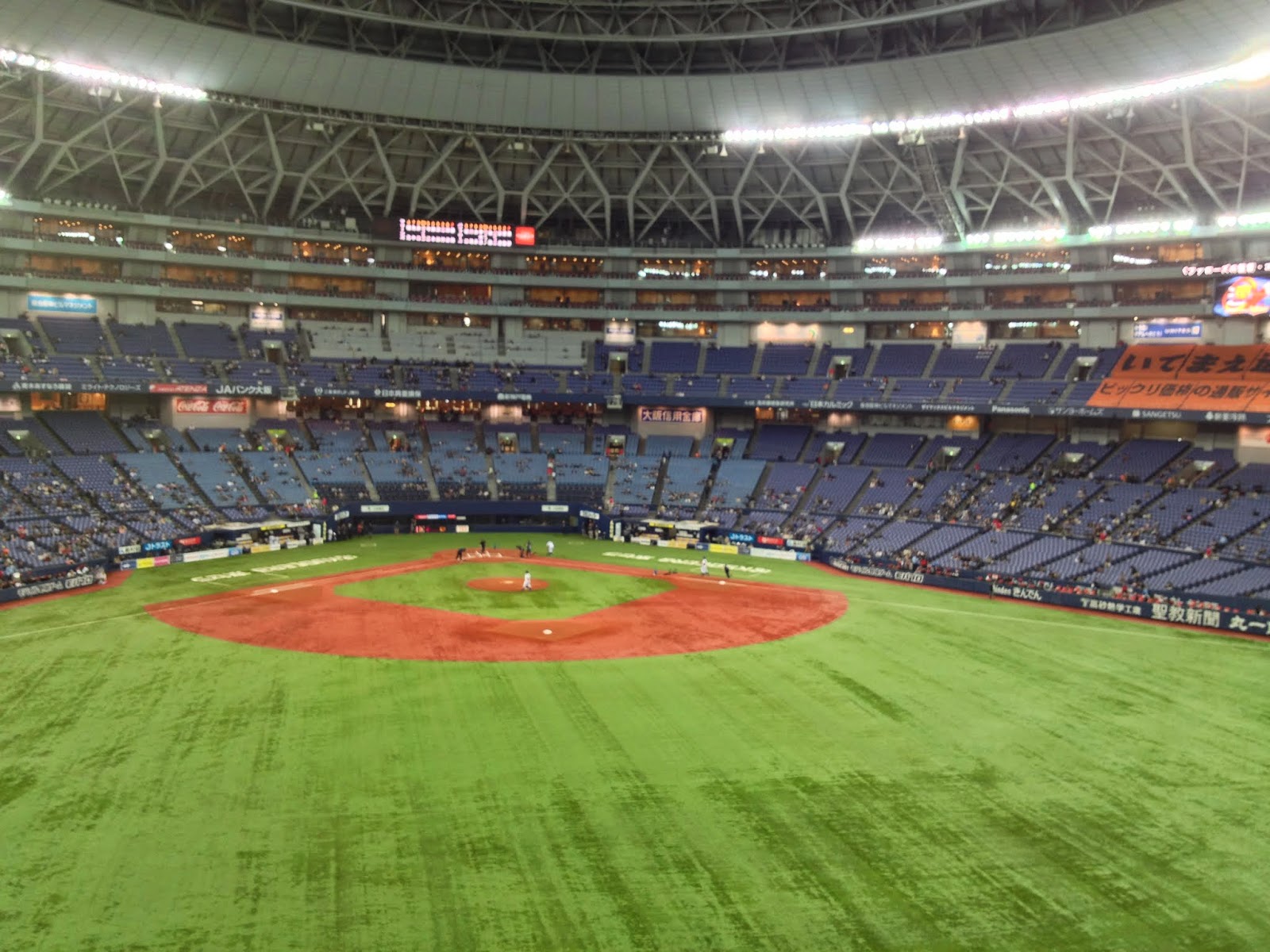
Here's the view from left field. If there's one thing you notice about this stadium early on, it's that it is huge. And with a very light weekday crowd it seems even larger and more empty. I think half of the fans in the park were in the two cheering sections.
The ceiling's pretty interesting. The seating, not so much. Despite being built in 1997, the stadium lacks the charm of US ballparks built in that era. It's big, cavernous, and cold.
Here's a view of the outfield seating arrangement. You can see many of the fans have found their spots in the lower outfield deck, which sits high above the playing field.
The stadium might be better if I could walk all the way around it and enjoy some of what is offered in the other sections. Or is there anything special back there? It might be possible to gain entry to that portion of the stadium, but I didn't see how.
The bowl shape of the seating with several rows, and a second deck pulled far back, is visible here. Everything seems so far away!
I had my zoom lens at maximum for this photo. If the fans weren't doing their cheering chants, it would have been really quiet in there. I could sometimes hear the ball pop into the mitt, or the crack of the bat, or some chatter on the field.
How about food? Well, I tried this massive hot dog. I'm sure it's about two feet long, and I had ketchup and spicy mustard on it. As far as hot dogs go, it was alright. And popcorn is never fresh in Japan. I think they pop it in China and ship it in. It's almost always prepackaged - there was the net outer covering, the popcorn cup, and a plastic bag with the popcorn inside that. Three packages for popcorn. I'm sure it cost more to package it than to pop it!
They had frozen Cokes! I miss these so much. Maybe I'll find one somewhere in Tokyo tomorrow. They're quite rare. You can get shaved ice things though in many places. I am thinking the good ballpark food was on the other side of the park.
Osaka Dome is about as good of a stadium for baseball as the Metrodome in Minneapolis was. They both feel the same. But for completists, it's on the list. And if you don't want to fight the crowds or heat at Hanshin, Osaka Dome may be a good choice.
It's located on the southeast end of the JR Osaka Loop Line. You can get off at Taisho Station and walk about five minutes west, heading toward the crazy metal wave behind the water storage balls.
Alternately, the Hanshin Namba Line and Nagahori Tsurumi-ryokuchi subway line stop one block from the stadium, but unless you're already on those lines it's usually quite an inconvenient station. The Tsurumi-ryokuchi line goes to Osaka Castle, so that might be a good way to get there. The block between the station and the stadium is an entertainment district with several restaurants and the team souvenir shop.
Technically, the Buffaloes have been around quite some time too, with the predecessor founded in 1936. But originally, that team was the Hankyu Braves, the ORIX Braves, the ORIX BlueWave, and finally merged with Kintetsu (whose team was formed in 1950) in 2005 to form the ORIX Buffaloes.
The Braves/BlueWave/Buffaloes have always called Kansai their home, and enjoyed success in the late 1960s through the 1970s and again in the mid-1990s when Ichiro was a member. But moving from Nishinomiya to Kobe, and then Osaka after the merger, has probably had some effect, and the lack of a strong rival and an identity crisis hasn't helped things.
The current home to the Buffaloes is Osaka Dome, also known as Kyocera Dome (sometimes written Kiyocera Dome). It opened in 1997 and was the home of the Kintetsu Buffaloes until the merger, and now hosts the merged ORIX Buffaloes.
I should mention that the Buffaloes play a few games each month in Kobe, the prior home of the ORIX BlueWave. Seeing a game there requires good timing and planning, and games seem to only be on weekdays or an occasional Saturday.
I arrived before the gates opened, a rarity in the past couple of years as I've often been sightseeing in the afternoon. There were two fairly long lines to get in, one for each of the cheering groups. They get there early to secure their seats in the general admission outfield.
I wasn't sitting in the cheering sections, so I took my time taking a few pictures and exploring back and forth across the outfield.
Here's the view from left field. If there's one thing you notice about this stadium early on, it's that it is huge. And with a very light weekday crowd it seems even larger and more empty. I think half of the fans in the park were in the two cheering sections.
The ceiling's pretty interesting. The seating, not so much. Despite being built in 1997, the stadium lacks the charm of US ballparks built in that era. It's big, cavernous, and cold.
Here's a view of the outfield seating arrangement. You can see many of the fans have found their spots in the lower outfield deck, which sits high above the playing field.
The stadium might be better if I could walk all the way around it and enjoy some of what is offered in the other sections. Or is there anything special back there? It might be possible to gain entry to that portion of the stadium, but I didn't see how.
The bowl shape of the seating with several rows, and a second deck pulled far back, is visible here. Everything seems so far away!
I had my zoom lens at maximum for this photo. If the fans weren't doing their cheering chants, it would have been really quiet in there. I could sometimes hear the ball pop into the mitt, or the crack of the bat, or some chatter on the field.
How about food? Well, I tried this massive hot dog. I'm sure it's about two feet long, and I had ketchup and spicy mustard on it. As far as hot dogs go, it was alright. And popcorn is never fresh in Japan. I think they pop it in China and ship it in. It's almost always prepackaged - there was the net outer covering, the popcorn cup, and a plastic bag with the popcorn inside that. Three packages for popcorn. I'm sure it cost more to package it than to pop it!
They had frozen Cokes! I miss these so much. Maybe I'll find one somewhere in Tokyo tomorrow. They're quite rare. You can get shaved ice things though in many places. I am thinking the good ballpark food was on the other side of the park.
Osaka Dome is about as good of a stadium for baseball as the Metrodome in Minneapolis was. They both feel the same. But for completists, it's on the list. And if you don't want to fight the crowds or heat at Hanshin, Osaka Dome may be a good choice.
It's located on the southeast end of the JR Osaka Loop Line. You can get off at Taisho Station and walk about five minutes west, heading toward the crazy metal wave behind the water storage balls.
Alternately, the Hanshin Namba Line and Nagahori Tsurumi-ryokuchi subway line stop one block from the stadium, but unless you're already on those lines it's usually quite an inconvenient station. The Tsurumi-ryokuchi line goes to Osaka Castle, so that might be a good way to get there. The block between the station and the stadium is an entertainment district with several restaurants and the team souvenir shop.
A Hanshin Tigers Game at Koshien Stadium
Originally built to host the national high school baseball tournaments, Koshien Stadium opened in 1924, making it one of the oldest in the nation.
Now, of course, it's the home of the Hanshin Tigers, one of the oldest teams in Japanese baseball. They have called Koshien their home since 1936, and high school tournaments and the championships are still played here. In fact, the high school games have scheduling priority over the Tigers games, so tournaments can cause rescheduling of Hanshin games.
There are several plaques on the outside wall near the plaza area on the first base side. Here's one for the Tigers winning a championship of some kind. I didn't see any information about it but those who know more about NPB history can probably date this. I'm guessing its from the 1985 Japan Series.
This one is of the stadium itself, prior to repairs completed in the past decade or so. The Great Hanshin earthquake of 1995 (known as the Kobe Earthquake) did some damage to the stadium, and it took about a decade before good plans were created; the improvements and repairs were completed in 2010. The ivy was preserved, the infield is still dirt, and the grass is still natural. But they changed the roof and reduced seating capacity, in addition to repairing the damage from the earthquake.
Also outside are several plaques honoring retired Tigers:
Out in the plaza, not attached to the stadium, are two larger plaques. One of them commemorates Babe Ruth's appearance at the stadium in 1934, during one of the MLB tours of Japan.
There's a Koshien Stadium Museum, which is certainly worth checking out. Unfortunately, I didn't. That makes at least two museums I've missed, including the Sadaharu Oh Museum in Fukuoka.
The stadium is beautiful, though, especially following an afternoon rainshower.
Afternoon rainshowers also bring rainbows!
Another shot. Koshien is the golden stadium, I suppose. The end of the rainbow is almost at home plate.
This gives you a view of the scoreboard and outfield seating. The seats are wider since the renovation, but there are no backs here. I spent almost all of the game in the seats, enjoying the game itself. I didn't really get out and explore, though I'm not sure how much is possible. The renovations might have made the stadium more accessible, but Japan has proven to be quite strict when it comes to moving around inside many of the ballparks.
I must have gone on an off-day. Yes, the stadium was packed, and the fans were quite into the game. But it wasn't as crazy and violent as others have said, and the cheering at other stadiums on busy days has been just as exciting. In fact, the Carp fans were more into the game in Hiroshima than the Tigers fans on my visit to Koshien, believe it or not. And last year's Golden Eagles game had a really great crowd.
Access is quite simple; take a Hanshin Main Line train to Koshien Station. Coming from Umeda Station (essentially Osaka's main station) express trains take only 12 minutes and local trains take 22 minutes. From there, it's a couple minute walk south; the stadium is literally just past the expressway overpass, which runs within meters of the stadium. Be sure to buy your return train ticket before leaving the station, because lines will be long on the way home. Or use a Suica or other pre-paid train fare card. Tickets should be bought well before the game, especially for weekend and holiday games, but same-day tickets are usually available on weekdays. Remember that you can buy tickets at convenience stores all over Japan, though you'll probably need assistance from a Japanese speaker. Employees have been willing to help when they aren't busy.
Now, of course, it's the home of the Hanshin Tigers, one of the oldest teams in Japanese baseball. They have called Koshien their home since 1936, and high school tournaments and the championships are still played here. In fact, the high school games have scheduling priority over the Tigers games, so tournaments can cause rescheduling of Hanshin games.
There are several plaques on the outside wall near the plaza area on the first base side. Here's one for the Tigers winning a championship of some kind. I didn't see any information about it but those who know more about NPB history can probably date this. I'm guessing its from the 1985 Japan Series.
This one is of the stadium itself, prior to repairs completed in the past decade or so. The Great Hanshin earthquake of 1995 (known as the Kobe Earthquake) did some damage to the stadium, and it took about a decade before good plans were created; the improvements and repairs were completed in 2010. The ivy was preserved, the infield is still dirt, and the grass is still natural. But they changed the roof and reduced seating capacity, in addition to repairing the damage from the earthquake.
Also outside are several plaques honoring retired Tigers:
Out in the plaza, not attached to the stadium, are two larger plaques. One of them commemorates Babe Ruth's appearance at the stadium in 1934, during one of the MLB tours of Japan.
There's a Koshien Stadium Museum, which is certainly worth checking out. Unfortunately, I didn't. That makes at least two museums I've missed, including the Sadaharu Oh Museum in Fukuoka.
The stadium is beautiful, though, especially following an afternoon rainshower.
Afternoon rainshowers also bring rainbows!
Another shot. Koshien is the golden stadium, I suppose. The end of the rainbow is almost at home plate.
This gives you a view of the scoreboard and outfield seating. The seats are wider since the renovation, but there are no backs here. I spent almost all of the game in the seats, enjoying the game itself. I didn't really get out and explore, though I'm not sure how much is possible. The renovations might have made the stadium more accessible, but Japan has proven to be quite strict when it comes to moving around inside many of the ballparks.
I must have gone on an off-day. Yes, the stadium was packed, and the fans were quite into the game. But it wasn't as crazy and violent as others have said, and the cheering at other stadiums on busy days has been just as exciting. In fact, the Carp fans were more into the game in Hiroshima than the Tigers fans on my visit to Koshien, believe it or not. And last year's Golden Eagles game had a really great crowd.
Access is quite simple; take a Hanshin Main Line train to Koshien Station. Coming from Umeda Station (essentially Osaka's main station) express trains take only 12 minutes and local trains take 22 minutes. From there, it's a couple minute walk south; the stadium is literally just past the expressway overpass, which runs within meters of the stadium. Be sure to buy your return train ticket before leaving the station, because lines will be long on the way home. Or use a Suica or other pre-paid train fare card. Tickets should be bought well before the game, especially for weekend and holiday games, but same-day tickets are usually available on weekdays. Remember that you can buy tickets at convenience stores all over Japan, though you'll probably need assistance from a Japanese speaker. Employees have been willing to help when they aren't busy.
Walk Through History: The Osaka Museum of History
When it's raining, the tourism moves indoors. But for local history buffs, this museum is worth a visit any day.
Outside the modern building, there's a reproduction of an old stilted wooden building. It appears that they open it sometimes, but I arrived right when the museum opened, and it was raining pretty hard, so I didn't think to enquire. That's alright, because there's lots to see inside.Located on multiple levels with very large spaces, the museum seeks to recreate history through life-size displays.
Here, you can walk through a royal palace. There are informational displays on either side. As you can see, the space is massive.
It's located across the street from two parks. Above, you can see Naniwanomiyaato Park, which is the historical site of Namba Palace. To the left, just outside the frame, is the park for Osaka Castle, rebuilt in the 1930s and renovated in 1997. I wasn't able to view that from the windows in the museum, and due to the weather and time constraints on this trip I didn't go to Osaka Castle.
The museum has some traditional "old stuff in display cases" too.
Here's a recreation of Namba Palace, I think.
More old stuff.
More dioramas.
I really enjoy the small models of cities. They're almost as good as life-size re-creations or village "theme parks" (when done properly).
This is one of the historic bridges of Osaka, and I believe there are modern versions of all of them to this day.
An old parade float.
Theatre masks.
Theatre costumes.
A mannequin with no head?
One floor has a very large area for children to play in. Here's an excavation site.
Modern history is included as well, including some Showa era displays.
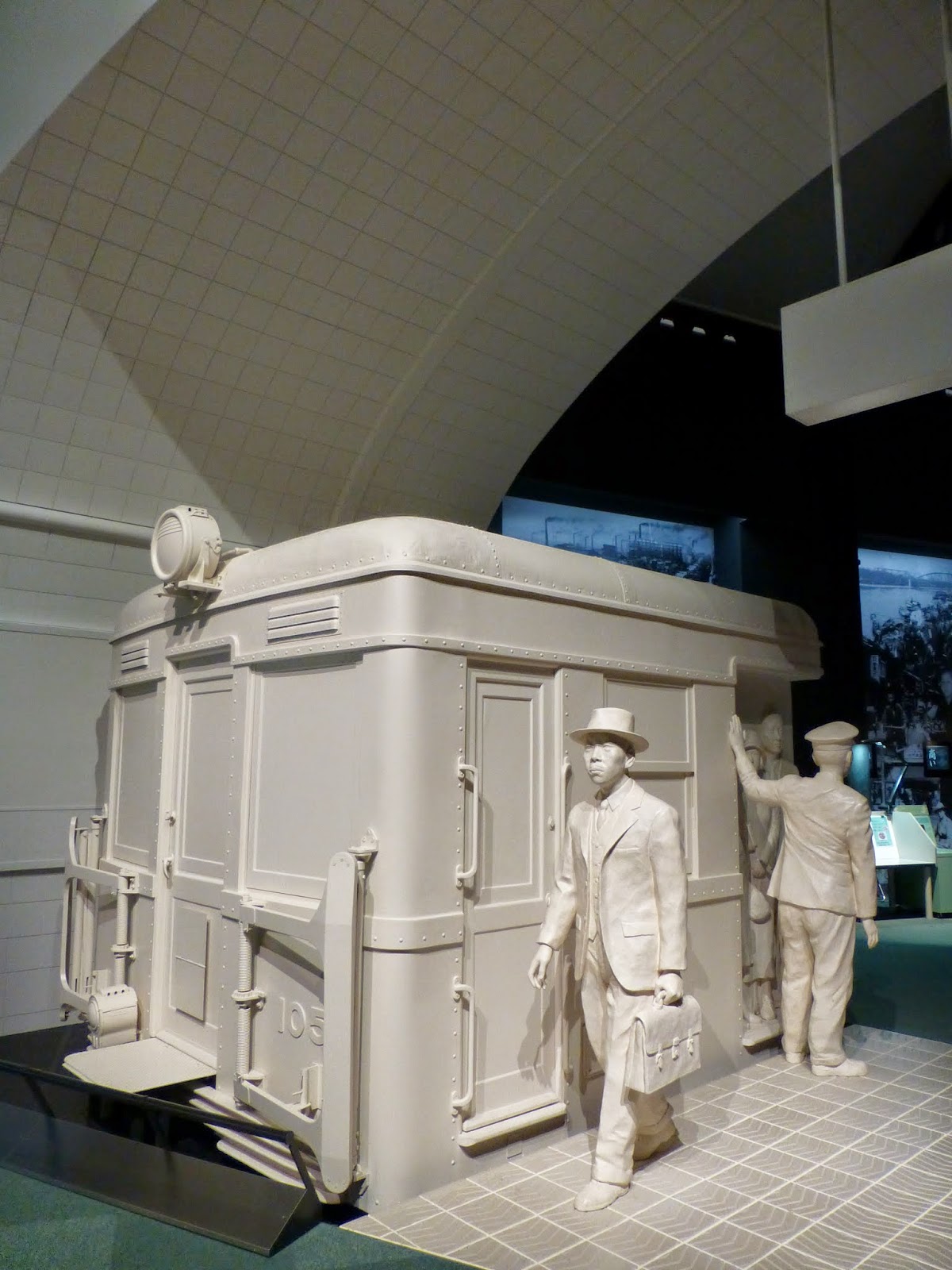
Ride the streetcar!
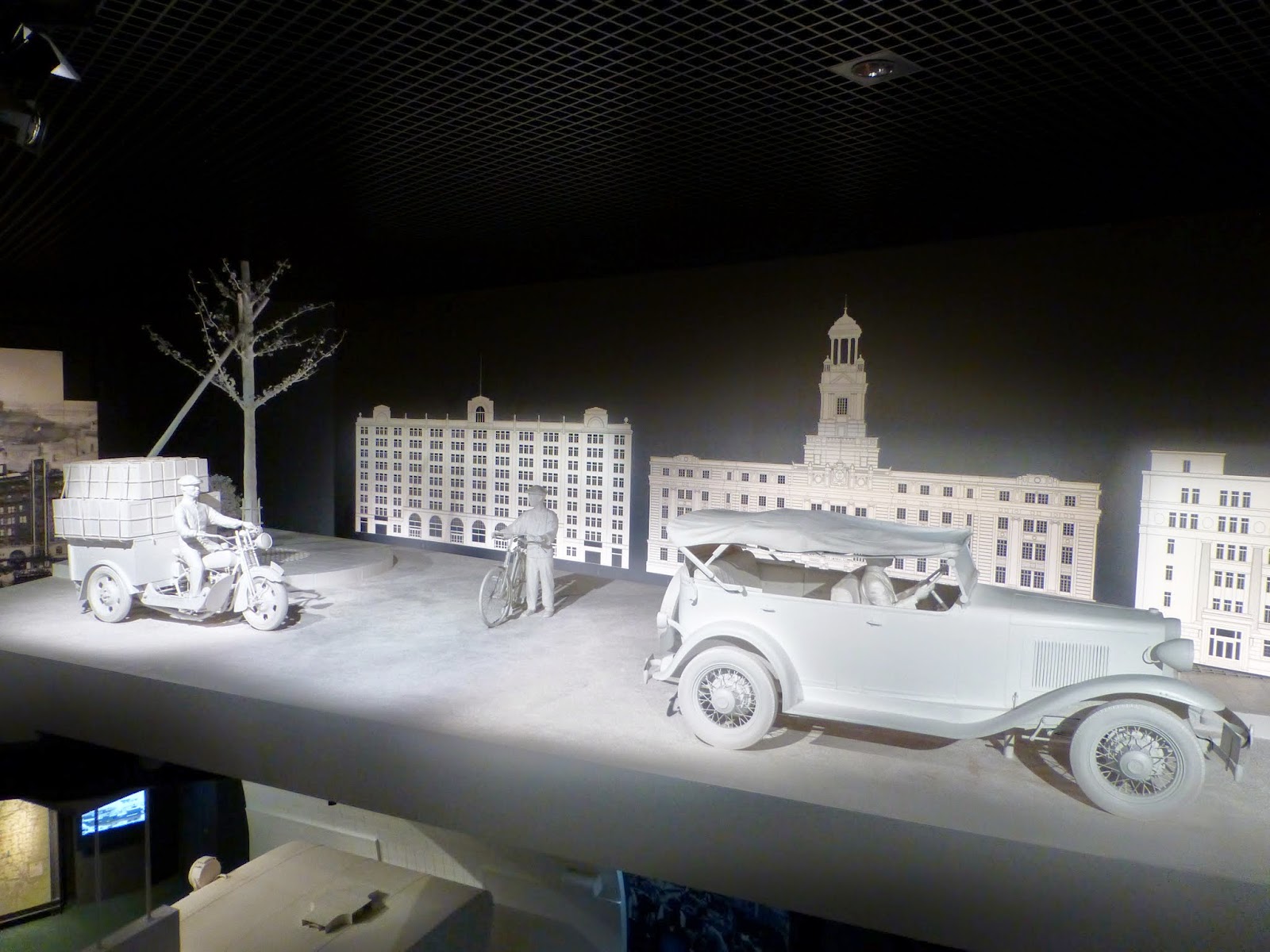
They've recreated an entire street with storefronts and artifacts.
An old fashioned market place with fresh food to cook that night.
It's dark, but still fun to walk down the "street" and see some of the goods on sale in the store displays. I wish there was a little more interactivity to the museum's larger exhibits. I could see where it would be fun to be able to go in the streetcar (instead of it just being a white closed box), enter the phone booth and hear someone having a conversation relevant to the area, or push a button or turn a knob in the stores.
Ahh, technology. One day, you're using a new-fangled electric sewing machine, and the next you're using a computer!
It's a fun museum, and if I had had more time, I would have stayed and explored more. But I had more on my plate that day, as I wanted to get to Universal Studios Japan to ride the coasters!
Osaka Museum of History is a five minute walk from Tanimachi 4-chome Station, across from the southwest corner of Osaka Castle Park in a large building. Take exit 9 or exit 2, and walk toward Osaka Castle Park; the museum is in a large building with large brownish diagonal tiles. It's open 9:30-17:00, closed on Tuesdays, and admission is 600 yen.
Subscribe to:
Posts (Atom)