Earlier this summer, I spent the day in Yokohama walking through a couple neighborhoods. My morning started with a little shopping and an art gallery, from where I headed over to Chinatown.
Yokohama Chinatown is the largest Chinatown in Japan, though these days most of the establishments cater to tourists. San Francisco's Chinatown has plenty of tourist shops and restaurants as well, but it still mainly functions as a Chinese neighborhood.
There are a few Chinese temples in town, and plenty of side streets to explore.
There are some authentic Chinese or Asian markets, with imported foods. But there are lots of restaurants catering to Japanese visitors.
And lots of souvenir shops. Some shops have souvenirs like snacks, keychains, and kitschy trinkets, while others are more authentic.
Those temples sure are beautiful...
Authentic goods include clothing - note the stereotypical Chinese dresses in the left-hand photo - and imported liquor and beer. I bought a bottle of Chinese liquor or liqueur here, but I don't know anything about it. I might have to open it and do a taste test some time!
You can't come to Chinatown in Yokohama and not eat. It just makes your visit pointless. If you have a sweet tooth, these sesame-covered balls filled with red bean paste and another sweet paste are pretty common.
A few stalls were selling these fried snacks that I thought were really tasty.
The most common food in Chinatown is the dumpling. There are dozens of locations from actual stores to small stalls selling these on the weekend. The cheapest full-size ones start at 350 yen, but these can be full light meals on their own.
There are dozens of varieties of fillings, though as you can see, most stores don't have English signage. The models on display will help you, and you can always ask the shop clerks, though they don't always have great English either. But...
Most people plan on having a full sit-down meal at a Chinese restaurant. Food is tailored to the Japanese palate, so it isn't really spicy. Several stores have all-you-can-eat options, but the $8 buffet from America doesn't exist here. Maybe it does... but I haven't found it. I wouldn't mind heading to some cheap buffets for lunch some time!
Expect all-you-can-eat plans to run about $20. Most don't have buffets, instead cooking the food to order. This will slow you down unless you keep ordering food quickly. And these are good options for families and groups who will enjoy sharing the dishes, so you can get a wide variety of food.
I did an all-you-can-eat in Chinatown once, with friends. There are plenty of "usual" dishes, plus lots of dim-sum. Note that some restaurants have received really bad reviews due to service or food quality. Do your research before you go and have a few options (with good maps) in mind. I wish I could help you in this area...
You can read my previous post about Chinatown here, Most tourists to Yokohama will spend some time in Chinatown, and for most people it should be on your itinerary for lunch or dinner! As you might be able to tell from the photos, the district is quiet on the weekdays, and quite busy on weekends. Some stores and restaurants close on a weekday or have reduced hours during the week but there's still plenty to experience and less crowds to fight.
Chowing Down at the Yokohama Cup Noodles Museum
On a rainy Monday afternoon, I made my way to the Minato Mirai district of Yokohama, heading past the CosmoWorld amusement park - open and functioning despite the weather - to one of those quirky museums that make Japan so awesome.
Cup Noodles are approaching 60 years old now, and it's not much of a surprise that they were created here in Japan.
After paying your admission, your first stop in the museum is a room with a massive variety of old ramen packages. I have to wonder where these came from. It started in 1958, with this simple plastic bag of Chikin Ramen. Not much has changed, has it?
Chicken soba (a different kind of noodle from ramen) and a curry-flavored ramen followed quickly...
Three walls in the museum are covered in packages, showing all (or most) of the varieties of instant ramen released in Japan on two of those walls; the third wall has a selection of international noodles.
This guy did all the work, and the rest of the second floor has an exhibit related to Momofuku Ando of Nissin Foods.
Most of this exhibit is in Japanese, though there is an English audio guide. I gather that it's free, though they require a deposit to borrow the audio set.
Apparently Mr. Ando worked in a tiny shack night and day to perfect his process.
A mock-up of this "workshop cabin" is included in the museum.
Lots of Japanese!
This was fun. Touch one of the photos and a shadow of a related/inspired product will fly from it. The bird below the ramen came from where the woman is standing (an airplane).
This was pretty popular - just shadows and inspirational quotes.
The history lesson soon becomes an art and kids' play museum.
Photo op! I see Babe Ruth!
For first time visitors, the second floor will help people understand the history of cup noodle development and production. But the real fun happens on the third and fourth floors.
The third floor is devoted to creation. In the photo above, museum visitors are coloring on their custom-made cup noodles. For about $3, you can choose the ingredients in your cup, have it sealed, and then decorate the cup with the provided markers. It's then placed in a special bag that makes it take up a lot of space. You can take the cup home and eat it, or just keep it forever.
Also for $3 (kids) to $5 (adults) you can participate in a noodle making class. You get to keep the fun yellow sanitary hats and I'm sure you can keep the noodles you make. While the cup noodle making experience can be pretty quick, the noodle making class takes a good bit of time.
The final exhibit floor of the museum is also split in two. One side has a giant play area for kids. It's designed to resemble the cup noodle manufacturing process. There are some little noodles entering the machine on the left, with another noodle coming out on the right, in the background. It looked pretty fun, and for $3 you can play all you want for 30 minutes.
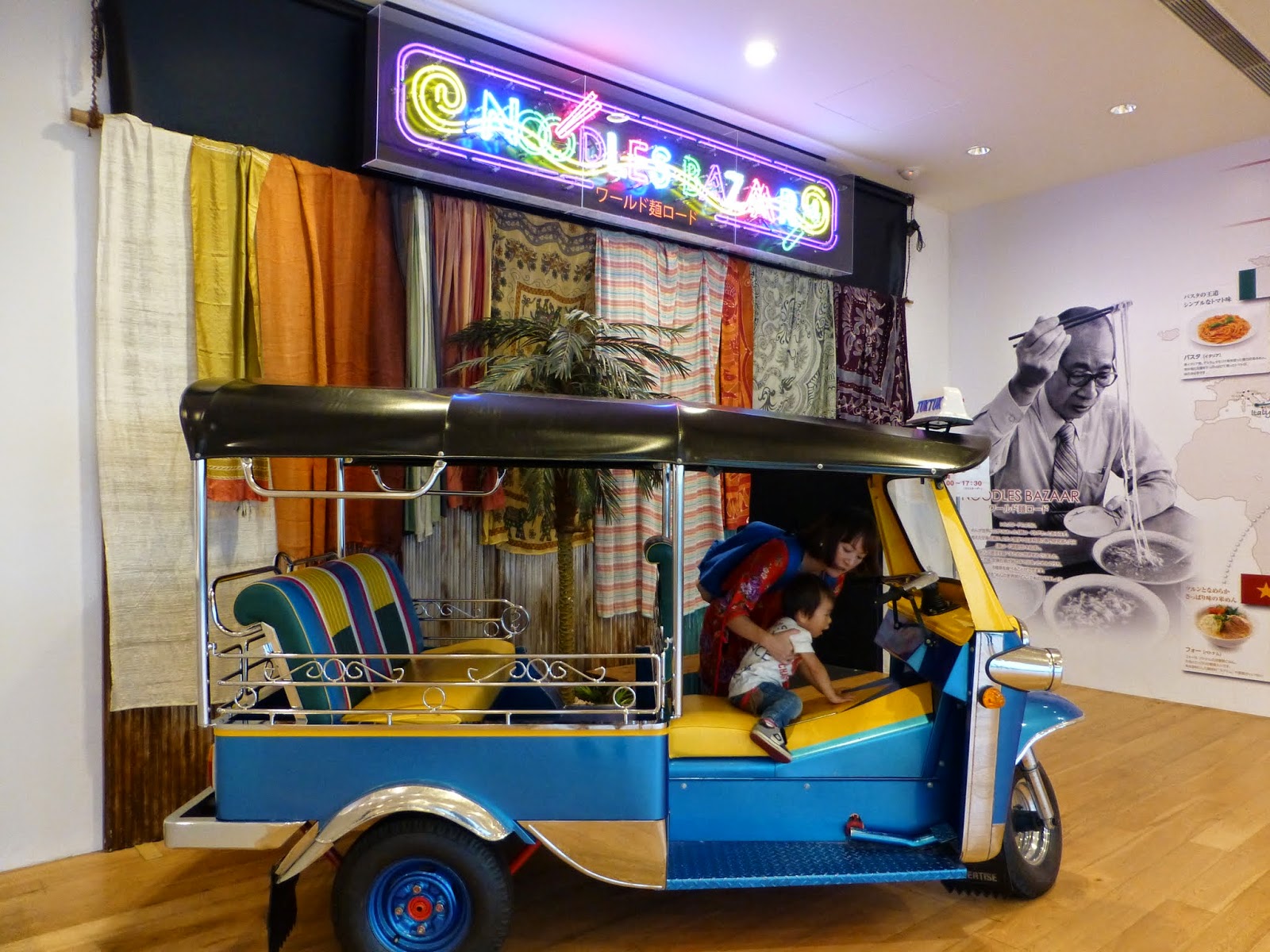
The other side of the fourth floor is the restaurant, called Noodle Bazaar. After getting your photo taken in the little vehicle, you can go in and sample a bunch of international noodle products.
The museum uses these as examples of noodles found around the world that Momofuku Ando "encountered" while traveling the world. That would be an awesome job, actually - I'd be happy getting paid to travel the world and eat local foods.
I spent most of my time at the museum in the Bazaar. The dishes are half-sized, and I hadn't eaten all day, so I easily downed two orders of noodles and one order of the custom mini-dish noodles.
I started with the chickin ramen. This is a small order of the original instant ramen, with your choice of two toppings from a selection of about eight. You can see the noodles as served; I went with pork and egg. It tasted, well, like instant ramen, but I certainly enjoyed it. This small order is 150 yen (~$1.50).
From there, it was off to Thailand. This is the spiciest ramen they offer. It includes a full prawn and plenty of vegetables, and you can definitely see the red spicy oil in the broth! It packed a punch, but wasn't overwhelming for me. I'm sure most Japanese people avoid this stand. The broth and noodles were great, but overall it wouldn't be something I'd eat regularly.
My final stop was China, for a beef ramen. This is their second-spiciest ramen, and there's some spicy pepper that you can add in to give it more of a kick. You can see my pepper at the back of the bowl. This was good, too, There are less vegetables here, but I could eat this one often.
I saw that they have a few noodle dishes that aren't soup - spaghetti was one of them. I would like to return and try the other noodles sometime. I saw they have a set offer that provides a discount, though I don't know the details. Each regular size bowl (half-size as compared to a regular ramen bowl) is 300 yen. Each country also has a local dessert (300 yen each) and a local drink (200 yen each) - a free-refill drink bar is 200 yen.
There's a gift shop with plenty of cool souvenirs and a little bit of overpriced instant ramen. Prices on the souvenirs are generally reasonable (for Japan), too!
Admission to the museum is 500 yen, but keep in mind that it's not worth visiting unless you pay extra for the experiences and/or food. The Cup Noodles Museum is open 10:00-18:00 (last admission 17:00), closed Tuesdays.
Access is a little bit tricky at first. It's best to arrive at Minatomirai Station on the Minatomirai Line (an extension of the Tokyu Toyoko Line from Tokyo). Follow the signs to Yokohama Cosmoworld (the station has several exits and it's a maze!) and then head toward the Ferris wheel.
You'll cross a bridge as you approach the Ferris wheel; continue following that street to the stop light, and you'll see the museum building on the opposite corner. Refer to the photo at the top of this post.
Evangelion (Art) Exhibition 2014 at the Sogo Art Museum, Yokohama
I'm back... mostly! My computer is here and operational, and I have it speaking to me mostly in English instead of Japanese! I've installed pretty much all of the programs I need and I'm working on my data now. I've also got a back-log of emails to attend to...
Evangelion is massive. What started as a 24-episode series has spawned several movies, multiple trading card sets, plenty of merchandising goods, and recently, even an art exhibition.
The art on display was directly related to the show and movies, though there were a few items from outside that universe. There were plenty of storyboard sequences and some cells from the original anime.A large portion of the exhibit had character sketches and pieces related to the main protagonists.
Of course, art relating to the EVA machines and settings were also viewable, including a large 3D map of sorts showing the Evangelion "world" and the main locations within. They included a few video screens showing the animation for running EVA units, and a short looping clip from one of the movies.
The gift shop was well stocked with anything you could imagine, with some exclusive goods. Prices were unsurprisingly high, and being on a budget, I was limited to buying just a small set of stickers. There were books with most of the works included inside, exclusive figurines, omiyage souvenirs (snacks in custom packaging), clothes, and more.
I have watched only one Evangelion episode all the way through - the pilot episode in Japanese - so I don't know most of the actual story, but I've become quite familiar with the series. Along the way, I've collected a good amount of Evangelion figurines and other goods. And what little I've seen of the show just makes me want to watch the rest.
Admission was 1000 yen, and given the amount of art on display, it was well worth it. I was hoping for some more "fan" art or works not directly taken from the show and movies. Of course, photography wasn't allowed inside, but there were four large statues scattered throughout the mall for which photos were permitted:
EVA Unit. These are pretty cool looking.
Here's the main protagonist, Shinji. I just saw online that you can buy life-size figurines like these for about $5000 each. Pocket change!
Here's Rei, one of the two main females on the show. She's calm and cool, much like her hair.
And the red fireball, with a personality to match, is Asuka. She's part German, and my favorite character on the show right now.
The exhibition was held at the Sogo Museum of Art, ending last weekend. It's the first of its kind, apparently, though an Evangelion art exhibition toured a few cities in Australia in 2013. A cursory search online didn't bring up any other exhibitions. There is an Evangelion store in Hakone (near Mt. Fuji - where the series and movies take place) and in Tokyo (Ikebukuro, reopening in early October).
Artwork images were found online, and come from materials related to the exhibition.
Subscribe to:
Posts (Atom)