Showing posts with label Asakusa. Show all posts

Asakusa's Sensoji Temple: Tokyo's Most Famous Cultural Landmark

 Let's face it. Tokyo is Japan, as far as most tourists are concerned. It is the capital, the biggest city in Japan, and probably has the most tourist destinations of any city in Asia, with all of its museums, shops, observation towers, gardens, and more. It's possible to get a good feel for Japan with a balanced itinerary in Tokyo alone. (That isn't to say that you should stay only in Tokyo; there are some very beautiful and unique sights all over the islands.)

Most people who can only go to Tokyo get their religious-cultural credit by visiting Asakusa. Just head away from the flaming building toward the temple's gate. Called Sensoji, the temple was originally built around 645. It is the oldest temple in Tokyo.
 Start at the Kaminarimon (Thunder Gate). Every time I've passed by the gate - rain or shine - there have been at least a dozen people taking pictures at the same time. Pass through the gate after taking your own picture - it's the symbol of Asakusa and possibly all of Tokyo.
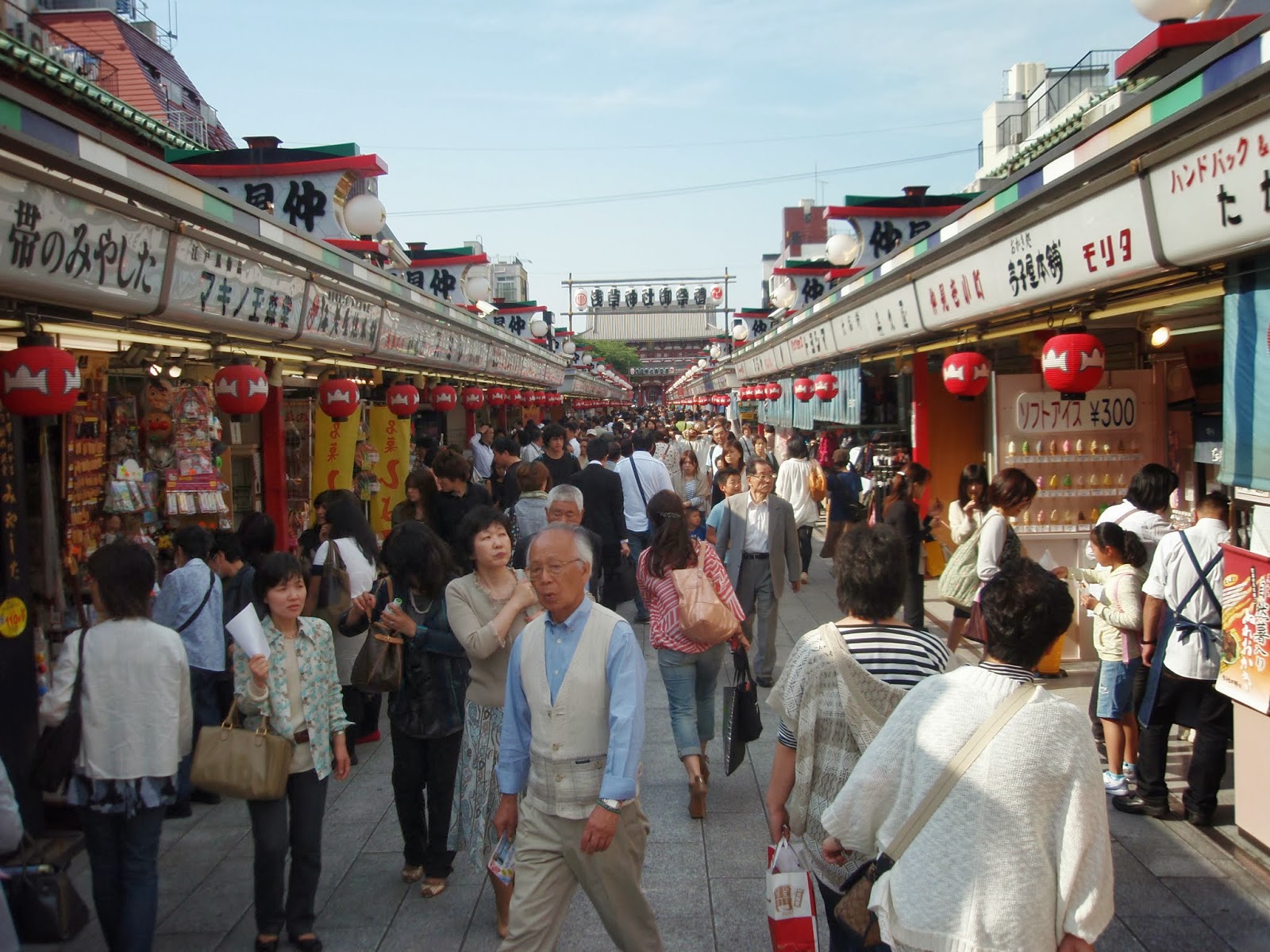
 A fairly long shopping street, known as Nakamise, leads to the second gate, called Hozomon. This is a surprisingly good place to get all your souvenirs for Japan that you can't find at the 100-yen shop. Be sure to shop around, because the same goods are found in multiple stores and prices aren't always the same. You can find yukata, fans, sake cups and other ceramics, typical souvenirs like keychains, and local snacks.
 Here's the Hozomon. Just walk through.
 I found a white paper lantern at a 100-yen shop, though I would like to buy a red lantern some time before I leave Japan. Different lanterns say different things though I don't know what this says.
 Ahead is the main hall. It was renovated in 2010.
 Walk up the stairs and admire the temple. Unlike many other temples, this place is overrun with tourists - it might be difficult to actually see real people worshiping, but then this makes it easier to take pictures.
 Look up. The ceilings are beautiful and my pictures don't do them justice.
 Each ceiling section has a different work of art.
 Each panel has a different meaning or purpose; dragons might be used for protection, for example.
 While temples are genereally simple, architecturally speaking, the insides are very beautiful, frequently holding ornate golden decorations.
 Nearby, you can see a five-storied pagoda. Most of the area was destroyed during the war and are, thus, reconstructions. Japan tends to be fairly faithful to the original design when rebuilding (at least, externally).
 This is a bronze Hokyoin-to. It is based on the Hokyoindaranikyo (Sutra of Casket Seal Itharani) - a Buddhist text. It was restored in 1907, after being damaged by an earthquake, and was originally cast in 1761.
 The bronze statue and several other smaller structures sit to the left of Senso-ji, at Asakusa Shrine.
 Most of the crowds ignore the shady, peaceful grounds, though the area has a much more modest feel compared to the gigantic, colorful, grand structures of Sensoji.
There's a nice little pond.
 Small huts are scattered along the pond and path.
 It's a beautiful location that is often overlooked.
 Compare the "crowds" seen here to the ones in the Sensoji pictures above. You'd think these pictures were taken miles apart instead of just next door. That should be the actual shrine building in the photo above.
 The grounds have a couple monuments or memorials.
This small roofed shrine structure sits quite photogenically in front of the five storied pagoda of Sensoji. I'm quite happy with this photo!

Beyond Asakusa Shrine, you can visit Hanayashiki amusement park or Kappabashi Dori - the restaurant shopping street full of everything you'd need to open and run a restaurant - except food. Asakusa also has restaurants to experience tea ceremonies, eat traditional Japanese food, and try on kimono. Nearby is SkyTree, Tokyo's latest landmark. As with any other tourist destination in the world, do your research on experiences and restaurants as some of them aren't as good as others.

Sensoji's grounds are always open, though the main hall itself is open from 6:00-17:00. Admission is free to everything, though those who visit are generally expected to throw a little change in the box.

Destination: Asakusa/Kappabashi Dori

For most foreign tourists, Asakusa is their taste of Japanese religion. Asakusa's Sensoji Temple is probably the most visited temple in Japan, and it is surrounded by other temples and shrines, allowing tourists to see and experience a small taste of how Japanese people follow Buddhist and Shinto ways. The famous shopping street Nakamise leads to the temple offering all sorts of local goods and souvenirs.

But Asakusa has other great sites within walking distance, and a whole day or more can easily be spent there. A Taiko drum museum (I haven't visited yet) is a couple blocks from the temple. Also nearby is Hanayashiki, a small traditional amusement park. Rickshaws wait to carry tourists around town on an expensive yet memorable tour, and the area still mostly has an olden-days feel.

But a short walk from the temples across the river bring you to two more modern destinations.
 On the left, with the golden top, is the Asahi Super Dry Hall; behind it with the white top is the Asahi Beer Tower. The tower is designed to look like a mug of beer, while the hall with the golden sperm/poo is actually supposed to resemble a golden flame. You can enjoy some beer and a meal in this area, or head further on to Tokyo SkyTree, towering to the right.
 Look down some side streets while you're there. This street probably hasn't changed since the 1950s. Unlike many of the other popular areas of Tokyo, Asakusa doesn't get bulldozed over for new skyscrapers too often. SkyTree is actually in Oshiage, not Asakusa.
 But follow the river south from Asakusa and look up at the short skyscrapers. When you find the giant chef's head, you've found Kappabashi Dori.
 Across the street from the giant chef is this building with coffee cup balconies. Kappabashi Dori is he place where restaurants and chefs go to get their equipment. Each store sells something different. One store may sell only knives, while another sells restaurant chairs and tables. At least one store sells only signs. Those little food models you see in windows outside restaurants can be bought here (I still need to buy one). Industrial-sized and hard-to-find ovens and specialty cooking equipment is everywhere.
 If you need glassware, find the store selling glassware.
 Do you need coffee pots or teapots? There's a store for that, with very beautiful copper and stainless steel ones sitting right outside.
 One of my favorite stores was the cookie cutter store. I'm sure they sold some other things but outside they had hundreds of cookie cutters in every imaginable shape. Amazing.
How big do you want your cookie? I counted up to five different sizes for one particular shape and there might have been more!

If you consider yourself a chef, you'll want to walk down Kappabashi Dori. Prices are good and quality is high, because this is where the real chefs of Tokyo buy their supplies. And you can find some really great gadgets here that aren't carried in American stores.

For any cultural tourist, Asakusa is a must-visit for the shrines, the older feel of the neighborhood, and the tallest tourist destination in Japan, SkyTree. You can get there via several subway lines, but it isn't located on the Yamanote Line (which may be why it hasn't seen as much redevelopment). It's taken me at least three afternoon trips to see the temples, Kappabashi Dori, Nakamise, Hanayashiki, and to visit the Asahi Tower. And I'll be back again soon!

Trip Report: Hanayashiki Amusement Park in Asakusa

This has become one of my favorite pictures. 

Who would have guessed that the amusement park closest to my apartment in Japan would also be the oldest? Hanayashiki is an old-style park with modern rides - everything is shoehorned into a tiny space in a corner of Tokyo.
 The park offers pay-one-price free passes and the park was pretty busy, but wait times were pretty short for most rides. This is Carnival, one of those little spin-in-a-circle rides. It didn't interest me. Nearby, a stage show was going on.
 Some kind of Caribbean show, it held the audience's attention well enough. I couldn't understand half of what they were saying, but I thought it was kind of fun.
 They did photos with kids afterwards. So I took a picture.
 Also next to the Carnival ride, this house was a "spinning room" attraction. You sit in a room and then the room spins upside down. Or you do. Who knows?! (Okay, yes, the room spins. And you rock back and forth.)
 Little Star was pretty fun. You climb into this, um, little star, and they strap you in with a wide waist belt. Then you go around in circles occasionally spinning upside down.
 Spin cycle: on.
 With so many rides packed into a small space, there are several photo opportunities. Tokyo SkyTree is visible from all over the park.
 Little Star is on the ground level. The park has a single coaster, a simple steel ride that circles the park.
 There's a building on one side of the park with several floors of small indoor attractions. On top, in the corner, is a small temple.
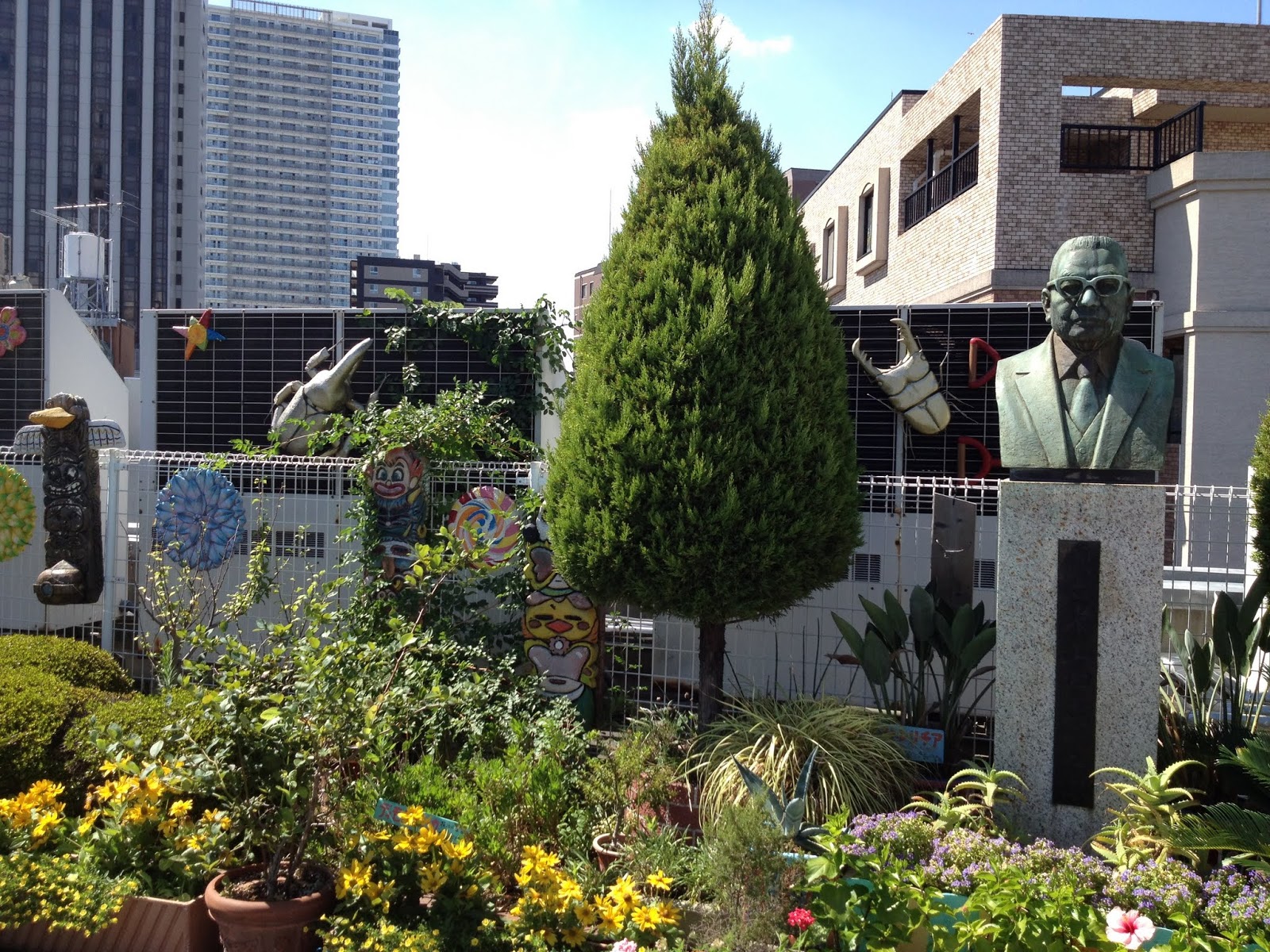
 There's a nice garden near the temple with potted plants and random odds and ends.
 I really like the giant sneaker planters.
 SkyTree isn't so big! The slowly-spinning flying candy house ride is taller!
 Reached from the second floor, two transport rides circle most of the park. There's a pedal bike on the pink track, and a pirate ship that hangs beneath the blue track.
 See, flying candy houses!
 The drop ride is taller than SkyTree!
 If you visit Hanayashiki, it's important to explore every corner of every floor of the park. You never know what you'll find. This is a little kid's car ride.
 Oh no! I'm going to be smashed by slowly-spinning flying candy houses!
 Hm, a unique shot of Carnival.
 From the pedal bike, this is looking back at the station for the bike and pirate ship attractions.
 In the middle of the park, there is an artifical mountain with a small cave/tunnel and some flower.
 Pretty, pretty flowers!
 A small lake is between the mountain and the drop ride.
 And the small lake (pond, really) is fed by this small waterfall.
 Cute little decorations are scattered around like someone's personal garden pond.
 DiskOs are fun rides, and I rode this one a couple times. It was pretty hot when I visited and I had other plans in the late afternoon, so I didn't stay long. Plus, how many times can one person ride DiskO in a row and not get bored?
While waiting for the flying candy houses, you stand right next to the coaster track. Check out this AWESOME shot. You could probably high-five riders who were prepared for it!
 Here's another picture of the DiskO, with one of the pirate ships going around.
 Once I finally got into a slowly-spinning flying candy house, I was able to get a better view of the park. The city of Asakusa is built up right around the park.
 It's easy to visit Hanayashiki, the Asakusa temple area, and SkyTree all in one day. Plan on staying at Hanayashiki just a couple hours.
 The coaster goes up the lift! It's really nothing special.
 More flowers!
 Anyway, the coaster doesn't have much room to do anything, and it's kind of painful. Being so close to everything else, the ride is pretty fun, but if it was retracked and/or better trains were installed, the ride would be much better.
 Slowly-rotating flying candy house.
 Slowly-rotating flying candy houses, flying. With Asakusa Temple and SkyTree in the background!
Once the sun sets, head across the river to Popeye in Ryogoku or the Asahi headquarters building for some great beers. Also to be found in the Asakusa area is a drum museum and Kappabashi Dori, a restaurant shopping district for serious chefs.

Hanayashiki opened in 1853 as a flower park, and as you've seen a small reminder of the gardens remains. Admission is 900 yen, and a free pass is an additional 2200 yen. The park is nearly open year-round with a closure for about a week in early December for maintenance. Several train lines reach Asakusa or the nearby area, and depending on the line you start in a different place. Note that JR trains don't go to Asakusa, though you can get there by Tokyo Metro or walking a bit further. Amusement park aficionados should plan to visit the park on a trip to Japan due to its history, and others looking for a few hours of fun with elementary school-level children will find it here.