National Museum of Korean Contemporary History, Seoul

 A relatively new museum in Seoul is the National Museum of Korean Contemporary History. As the name implies, the exhibits focus on Korea's history over the past 100 years or so.
 The entry lobby has a really neat display screen that moves like sliding doors.
 Korean flags from various historical events.
 The first few exhibits start around the introduction of western culture and the Japanese annexation.
 The older exhibits are mostly documents...
 But as you move towards the wars you get more artifacts.
 I really like seeing old textbooks. They frequently have interesting artwork (especially in science books) and for subjects like math they can be understood without knowing the language.
 The first motor vehicles were called "Sibal" and used some parts from US military jeeps. They first went on sale in 1955 and more than half of the engine parts were made in Korea.
 Maps are almost as cool as textbooks. At least, the old ones.
 Safety first!
 As South Korea recovered from the Korean War, it moved more into manufacturing goods.
 This is a KIA truck. I don't recall seeing any three-wheeled trucks in Korea on my trips.
 As Korea grew, highways were built, including this one connecting Seoul to Busan.
 Korea is probably most known for providing home electronics, especially from Samsung and LG.
 Of course, automobiles are exported as well - Hyundai and Kia. This is the Hyundai Pony 1, from 1982 - Korea's first own model car.
 One section of the museum looks at home life in Korea. Here are some goods from the past, including some models of traditional homes and modern apartments.
 There's a mock apartment room, complete with newspaper-covered walls.
 See what working life was like in another room.
 Continuing on, an exhibit on popular culture shows several popular movies and TV shows. The first color TV broadcast in Korea was in 1980.
 This exhibit looks at several aspects of pop culture in brief, including some KBO details.
 Music, movies, and fashion all have their own exhibits as well.
 A replica of the President of Korea's office and podium nearly finishes the tour. You can take a seat or stand behind the podium and get your photograph taken.
There's a separate museum for the Olympics but this museum has a few exhibits from the 1988 Games.
 The last part of the exhibit looks at very recent history - the opening of the KTX high-speed line and Korea's place in the technology markets.
 Korea is a manufacturing center for computer chips, such as memory.
And of course, LG and other manufacturers contribute a lot to the cell phone market.

Find Anything at Dongmyo Flea Market (Hwanghakdong), Seoul, South Korea

The Seocho Flea Market may be the best due to the multitude of households setting up, but Dongmyo certainly is worth some of your time. I've seen this market referred to by different names: Dongmyo, Dongdaemun, and Hwanghakdong. Note that this is not Dongdaemun Night Market, which is a very popular collection of shopping malls.
 This market is quite spread out, and merges with the Seoul Folk Flea Market to make for one massive collection of old junk. It goes up and down many side streets in the Dongmyo area, and includes several people setting up on the sidewalk along the main drag as well.
 There's a core area to this flea market that appears to open every day, with dedicated sellers generally carrying specific goods that they keep tucked away in garage-like sheds along the street. But on the weekends it spreads and attracts the part-timers with things to move. And that's where you get all kinds of strange goods for sale.
 Almost everything under the sun is sold here, under the sun. Clothes, tools, household appliances, souvenirs, and anything else you could imagine is sold on the busiest days. I've seen imported food, fake and real branded goods, jewelry, makeup, CDs and cassettes, strange electronic goods, kitchen goods, and strange things that couldn't possibly ever sell. It is in this market that I found my baseball jerseys and saw many more things I wish I could have brought home with me.
I liked this guy's look that I just had to post both images. He's obviously a full-time seller. Your best bet to visit the flea market on a Saturday is to go to Dongmyo Station, and take exit four. You should see some people set up right there, and just weave your way up and down streets with dealers. Making your way east toward Dongmyo Shrine, you'll reach the main core of regular sellers, and the center of the market around the shrine. The weekends offer the most selection, and the biggest crowds. But even in the winter, on cold, wet, snowy days, there will still be people set up selling their wares.

On good days, you can continue following the lineup of dealers and other sellers east all the way to Sinseol-dong Station, and the Seoul Folk Flea Market. I'll have a full post devoted to that market in the future, which has a permanent indoor space as well as a decent collection of outdoor sellers on the weekend. It seems that the unofficial/official line between the two markets is Nangye-ro, a major north-south road.

Bargain Hunting at Seocho Flea Market, Seoul, South Korea

When it comes to travel, my Japanese students always talk about two things: food and shopping. And it's true that Japan, and all of Asia as well, has wonderful food and a wide variety of shopping options. When you look at the prices for name brand goods, you then understand why traveling to another country becomes an option - a weekend of ethnic foods and discounts on high-price cosmetics and clothes makes that plane ticket worthwhile.

But I'm a cheapskate. I love to spend money but I'm all about the value; thrift shops and bargain bins are my friend. That's something I really miss about America; Japan doesn't have much of a used goods market. But Korea does, in spades.

With many of my plans rearranged or canceled due to weather, I spent a good bit of time on both of my trips to Korea exploring shops and markets. On Saturday, I started my day at the Seocho Flea Market, a few steps away from my hostel.
 Bangbaecheon-ro is split down the middle with a parking lot from Sadang Station to Isu Station, and it becomes one of the largest flea markets in Korea. The majority of goods are clothes, and most of those will be women's clothes. But you can find bags and accessories, hats, children's clothes, toys, and more.
It's a real flea market, with people selling all of their random goods. You can tell the household spots from the regulars, because the regulars tend to focus on one type of good. Either way, you can find some great deals. Do you need some new tools? You better have checked luggage, because you can't carry that hammer back on the plane.
 Perhaps you'd like a musical instrument. Or electronic goods. Or CDs, VHS tapes, DVDs, and more. Come prepared to test anything you buy, because like any other flea market it's buyer beware and dealers generally won't have an outlet to test that appliance.
Some dealers specialize in vintage, antique, or foreign goods, and the individual household sellers might have some of these items as well. I found a traditional Korean drum and a new Korean baseball hat to take home - for about a dollar each. This isn't a tourist market, and you shouldn't plan on getting souvenirs here, but if you want some real Korean goods at a discount this is the place to go! It wasn't the best flea market in Korea as far as finding things I personally wanted, but it might be my favorite - lots of household sellers and a friendly atmosphere.

Seocho Flea Market happens every Saturday, starting about 9:00. Sellers start heading home about 2:00, so arrive early. This market is known for the old people who can be quite pushy, so come prepared to stand your ground and act fast - stuff sells fast as the place is crowded.

The easiest way to get there is to take the subway to Sadang Station. Don't use Exit 1, like some websites say. Instead, go to exit 11 [best] or 13, and turn right down the small side street. In a block, you'll arrive at the split street and you should certainly see all the people buying and selling. Just follow that one street all the way to the end of the market, heading north. You can turn left down one of the cross streets to get back to the main road, and turn right (north) to get to Isu/Chongshin University Station.

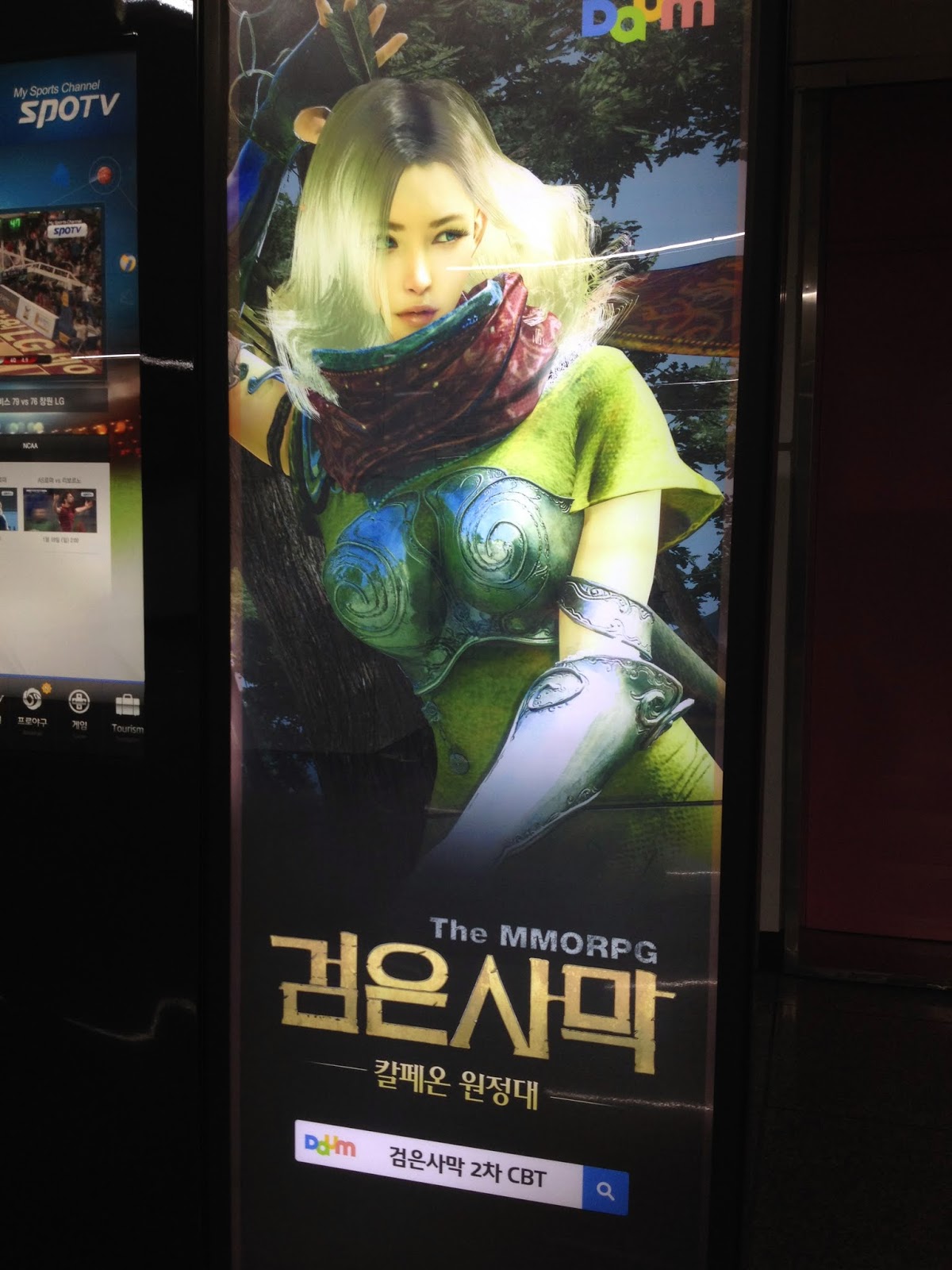
Welcome to Korea. Let's play a (MMORPG) game.

Koreans love video games. This full-size, prominently placed advertisement found in a major train station attests to that. Card games, like Magic: The Gathering (and plenty of others, of course) are also pretty popular; I've seen packs available in convenience stores and supermarkets.

The strange thing is, I've never seen a gaming center or even a card store in Korea. I've seen tables set up in American card stores for card games (or just for pack busting, of course) and Japan's stores frequently have space or even entire rooms for players to gather and have tournaments.

If anyone knows of any locations for CCGs (especially stores) I'd love to know. There's a chance they could have baseball cards! Or, perhaps something else interesting to buy. And to answer your question: no, I've never played a card game. I wouldn't mind trying sometime, though!

Seoul's Subway System: Prepare for Attack!

Seoul is huge. Individual neighborhoods aren't that large, and it's not too difficult to explore a neighborhood in an hour or so. But there are tons of little neighborhoods, and Seoul's important sights are spread all over the city and metro area.

Getting around takes time, especially going from one end of the city to the other, but the subway system is quite dense and inexpensive, and the trains are quite frequent. Tokyo as a tourist destination is smaller, though the Tokyo metro area is larger. 

Tokyo has unbelievable accessibility, but the network is a combination of JR, private rail, and Tokyo Metro lines. This means that the fastest, easiest, or most convenient route might involve changing companies, drastically increasing the overall fare. Seoul's network functions under one organization with one fare structure, which helps keeps rates low even when transferring lines.
 The subway cars themselves are always clean and fairly large. Different lines can have different styles, most likely relating to when they were purchased. They're usually pretty crowded, but I rode Line 4 on one of the last trains of the night one night and it was quite empty, so I was able to take a couple pictures.
 Some of the trains have really nice etched metal doors. Those metal seats aren't exactly comfortable, but most lines have cushioned upholstered seats. Like Japan's trains, graffiti and trash are nowhere to be seen. Most trains announce stops in English, and there are digital signs on most trains that announce stops in English as well. The stations have English-letter signage too, and there are plenty of maps. I actually prefer Seoul's transportation system to Tokyo's, due to the much-lower cost.

As I mentioned, the lines are always busy, and during rush hour the cars are packed. People don't push and shove onto the trains like they do in Tokyo, though. There's a tap-and-go card that works on the subway, on buses and taxis, and in stores, which I highly recommend. It provides a discount (especially useful when using the subway and buses) and is much more convenient than buying a token for every trip and getting a refund for that token when you leave. If you're going to stay in Seoul for more than a couple days it pays for itself.
One thing you will notice in subways is the abundance of "Relief Goods Storage" cabinets. These have gas masks and food in case of emergencies. The gas masks function in fires, of course, but let's be honest here. Seeing these remind you how close you are to North Korea and the possibility of war.

But don't let that deter you! Seoul is a wonderful place to visit with great food, sights, shopping, and transportation!

Seoul Station: Where have I seen this before?

Seoul Station is the main departure point for all points Korea in Seoul. It's not the only one, though - Yangsan Station has high speed rail trains down the west coast, and there are plenty of bus terminals and other major stations in town if you're heading to other places in Korea. 
 This is the third Seoul Station. The first, opened in 1900, was originally named Namdaemun Station, as Namdaemun is nearby. In 1910, a new structure was built and named Gyeongseong Station, due to Seoul's name being changed from Hanseong to Gyeongseong by Japan. The current "old" station, seen above, was opened in 1925 as Gyeongseong Station. It was renamed Seoul Station in 1947.

The building has a Byzantine-style dome and brick facade that reminds me of somewhere particular, but I can't remember exactly. I believe it's a university or museum of some sort, though I'm sure there are probably dozens or even hundreds of buildings that have a similar style. There are probably buildings just like this in Tokyo that I just can't recall!

Anyway, the old Seoul Station still stands. Renovations were completed in 2011 and it now serves as a cultural center; the new building is just south of the old one, and much larger, modernized and designed to handle the KTX high speed rail lines. At nearly 100 years old, it's worth seeing if you're a history or architecture fan, though getting inside will probably require attending an event; for what I understand only the shell is preserved.

Hungry Yet? Walking Through A Traditional Market in Seoul

Traditional markets are a big part of Asian culture. In Japan, they're not as popular, though Ameyoko is still going strong, certainly catering to tourists but also selling fresh foods including fish. And of course, the Tsukiji Fish Market is a very active part of the restaurant business. Tokyo especially has seen the small shops move into purpose-built actual structures (with offices, more shops, or housing on top), and many of the same shops gathering in one neighborhood.

But in Taiwan and Korea, I saw plenty of markets selling, well, everything. One evening on my first trip to Korea, I found myself wandering around a market area that led to another market which had tons of food and kitchen products.
 I understand that at many of these markets, you can buy your fresh meat, fish, and vegetables here, have the sellers cut it as you wish, and then take your purchases to nearby restaurants to cook your own food! Or you can bring Mr. Clingy home with you.
 This particular market, the name of which eludes me, is quite long with hundreds of stalls.
You can find all sorts of vegetables here.
 Of course, fish is readily available.
 I don't know what most of the stuff at some stalls was.
 I know tomatoes! And the other fruits here!
 A few shops had kitchen goods and tableware. I found a pretty cheap pan here that I brought back and am still using!
 Nuts, seeds, berries, dried fruits...
 Prepared goods, like wafers/cookies.
Kim-chi and other kinds of massively spicy foods are readily available too!

I wish I knew which market I went to, partly because I'd like to go back again sometime. But there are plenty of traditional markets in Seoul and around Korea. And I hear the spicy food is really spicy when you go local.