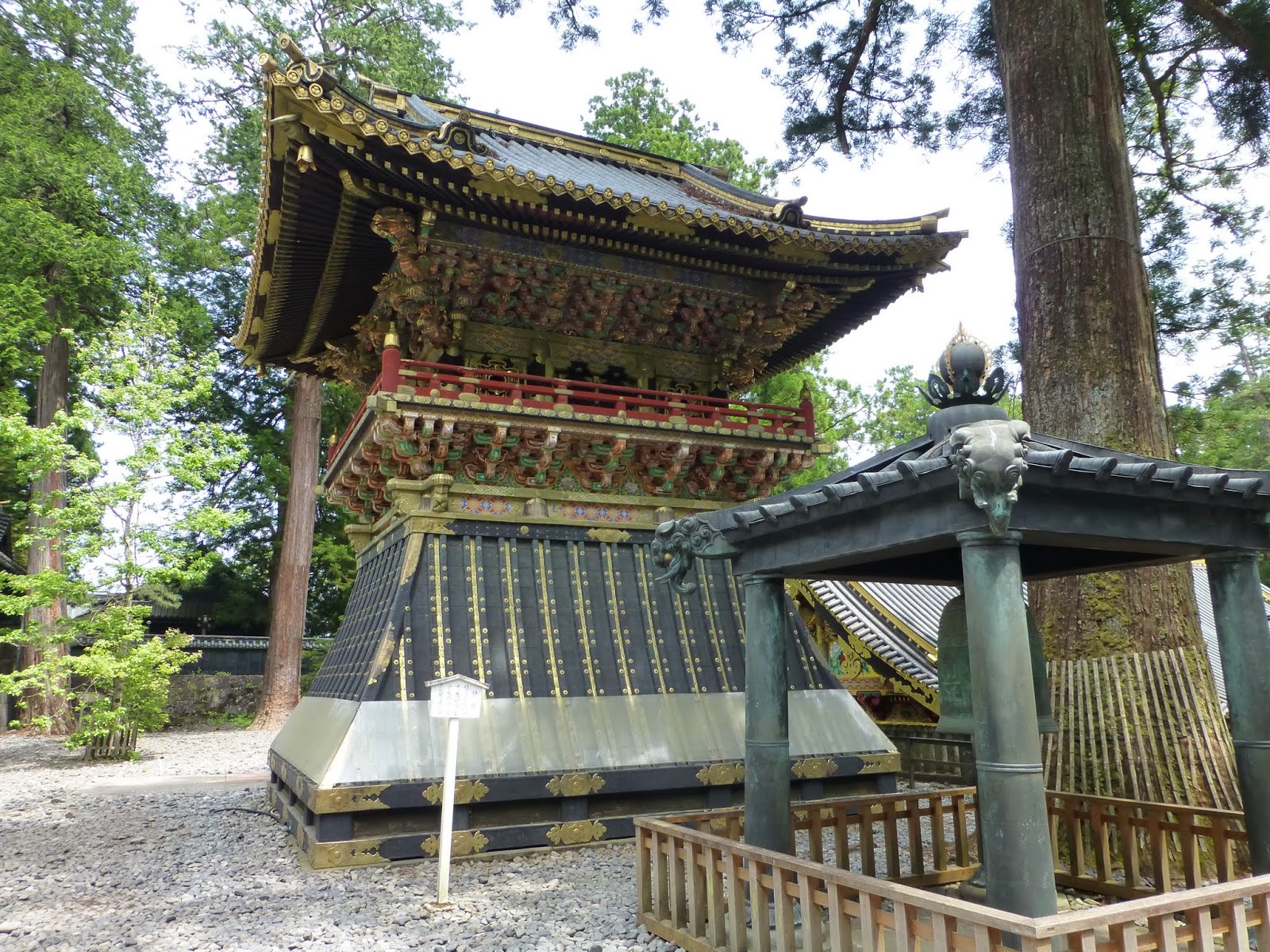
New Years Day in Japan is the same as Christmas in America, in many ways. Christmas isn't a holiday here, and the important part of Christmas is the night before, when families eat fried chicken (turkey isn't exactly common) and cakes and open presents, and couples head off to love hotels for some hanky panky (Christmas is the most romantic day of the year in Japan - even more than
Valentine's Day).
But for New Years, people head back to their hometowns to see their families and almost everything closes. Stores shutter their doors for three or four days and most museums turn off their lights. Families hang wreaths and put bamboo decorations outside (for luck/religious reasons) and put out a special New Years cake with an orange on top. Instead of Christmas cards, everyone sends New Years cards. And early in the morning on January First, millions of Japanese people go to their local shrines to pray for the coming new year.
So, seeing how it's New Years Day, this is a perfect time to post about the most famous shrine in Japan - though possibly
Asakusa's Sensoji may be Japan's most popular religious destination.
Sandwiched between the
yuba lunch and a late afternoon stop at
Kegon Waterfall, my tour group had time to explore Nikko. There was a limited amount of time, and there's a lot to see in Nikko, but we decided to tackle the most important: Toshogu Shrine.
Toshogu is important because it is the final resting place of the founder of the shogunate that ruled Japan for two and a half centuries. It's a large shrine with several buildings containing beautiful carvings. You start by taking the long apprach from the road.
Ahh, almost there!
Before entering the main paid area of the shrine, a five-storied pagoda can be seen to the left. It's open to the public sometimes, if you pay an extra fee.
Be sure to enjoy it from the outside, at least, during your visit.
Pass through the gate with your ticket! Toshogu is very colorful and ornate.
We followed a somewhat counter-clockwise route through the shrine grounds, which begin with these lanterns and then a couple storehouses.
Ahh, there's one! You'll see this later.
Lanterns are fun, and the building in the background is quite important.
Across from the important building is one that looks really nice.
Beautiful!
Why is this building so important? It's a small storehouse with very little visible color.
Hmm. I see monkeys.
Look familiar? These are the famous three wise monkeys - western knowledge of "see no evil, speak no evil, hear no evil" comes from this carving.
It's actually part of eight panels. The first panel shows the mother looking for the future of her child. The three monkeys depict how children should act. Now, the child is preparing for independence.
The child, looking up to the sky, with a big ambition (blue clouds).
Facing life and crossroads with help from friends.
Here's a closeup of the three monkeys.
This angle is so much more interesting! OK, back to the story.
Here, the monkeys fall in love.
The monkeys are married; life is difficult like a tidal wave.
Now, the child monkey is an adult, and she is pregnant. The life cycle story begins again...
The panels wrap around three sides of the storehouse.
Okay, enough monkeying around. Time to head to the main buildings.
Wash your hands and cleanse yourself, first.
This is the Yomeimon Gate, and I was able to see it uncovered. It has been covered with scaffolding to be renovated over about 6 years! The gate is said to be the most ornate structure in Japan.
The wall with a corner of the gate in the upper-left.
Nearby structures.
Be sure to look inside the gate.
Look up.
Examine the pillars. More on this later.
This is the main shrine, through the gate. There is a large painting of a dragon on the ceiling of one of Honjido Hall, and when two pieces of wood are clapped together directly under the head, it makes a ringing sound that has earned the dragon the name of "Crying Dragon" - you can experience this for yourself frequently as demonstrated by a priest. And you can then go into the main shrine building as well.
Kirin is a mythical creature that looks somewhat like a lion-dragon. There are several kirin figures found around Toshogu, and Kirin beer is named after the creature, so it's only natural that Kirin would have a display at the shrine. (Those are sake barrels behind the beer display case.)
These look more like dragons than kirin to me but I might be wrong.
Hmm. Something's going on. We'll come back to this later, too!
But, first, find the nemurineko (sleeping cat). It's small, located above a doorway. Pass through that door (Sakashitamon Gate) and you see...
Stairs! It's a long way up to the mausoleum! Expect to be climbing stairs for 5-10 minutes or more, depending on your stamina.
At the top, you're greeted by another storehouse, with the mausoleum behind it.
The entrance to the mausoleum; you use a side viewing path instead.
It's a dignified but simple place for Ieyasu.
A tree with a hollow cove is on the left side of the mausoleum, and supposedly brings good luck.
Small turtle-shaped rocks surround the mausoleum. Let's go back down to the main shrine.
From death, to life. The wedding ceremony is over! Yes, I happened to see some of a traditional Japanese wedding at Toshogu Shrine! That was a great mini-experience in itself.
The altar.
This is the gate to the main shrine again, with extremely ornate carvings.
Our visit was timed almost perfectly; the restoration of this gate was complete and thus it was quite shiny and new, and the other restoration work had yet to begin.
More carvings.
Off to the left is another storehouse, called shinyosha, holding portable shrines.
The ceiling has some nice artwork!
Of course, look at the shrines, too.
I wonder if these are used or if they're only for display now. It seems like it would be quite difficult to get them out of the shrine now.
Here's a closeup of the ceiling.
Okay, back out through the Yomeimon Gate. If you pay close attention to the pillars, you'll noticeone is different from the others. There are twelve columns total, and only one of them is upside down, to avoid making spirits angry or jealous.
Here is the other guard in the Yomeimon Gate (the first was seen earlier in the post).
There is one more famous carving to be found in Toshogu. The building across from the monkeys storehouse has colorful carvings of elephants, done by an artist who had never seen an actual elephant.
Goodbye, five-storied pagoda! And goodbye Toshogu! We spent about two hours at the shrine, and saw everything there was to see. Nikko may be a major tourist attraction with lots of touristy things, but Toshogu itself is certainly worth the trip!
Toshogu, and everything else Nikko-proper has to offer, is about 30-40 minutes away on foot from the JR and Tobu Nikko train stations. Or you can take a bus (about 10 minutes, 300 yen). The grounds are open 8:00-5:00 (closing at 4pm November-March), though I recommend allowing two hours to see everything (you may take less time, but it's better to be safe). Admission is 1300 yen.